Orion Nebula (M 42)
Orion Nebula (M 42) is a cluster + nebula in the constellation Orion, magnitude 4.0, 1.4° × 1.0° across.
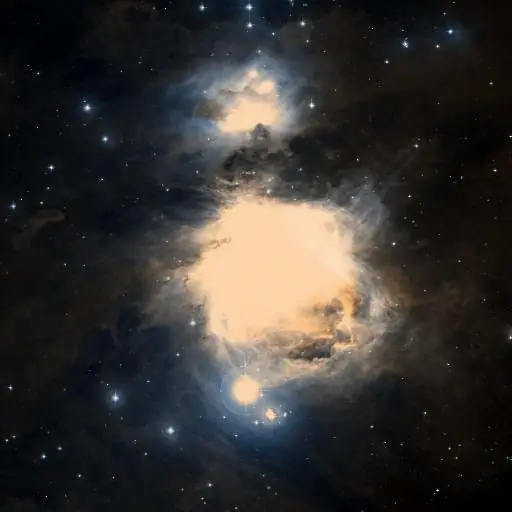
The nearest great star factory — where we can watch planets begin to form around newborn suns.
Few places have taught us more about how stars and planets are born. The Orion Nebula is the closest region of massive star formation to Earth: an emission nebula with about 2,000 times the Sun’s mass, lit by a crowd of young stars. Since Hubble first looked in 1993, it has found discs of gas and dust — the raw material of planets — around most of the newborn stars here.
Oddly, no one seems to have recorded it before the telescope. Ptolemy and al-Sufi listed other hazy patches but not this one, and Galileo never mentioned it, though he studied the stars around it. Nicolas-Claude Fabri de Peiresc is credited with recognising it as a nebula on 26 November 1610. In 1880 Henry Draper exposed a photographic plate on it for 51 minutes — the first photograph of a nebula ever taken.
Its colours once fooled scientists. A green glow matched no known element, so some proposed a new one: “nebulium”. The truth was oxygen, glowing in a way that needs the near-perfect vacuum of space.
Orion Nebula (M 42) is 1,400 light-years away: the light we see from it set off around AD 630, 90 years after the Hagia Sophia was completed in Constantinople.
Did you know?
- Embers of creation. Some scholars think the Maya saw Orion’s Sword, nebula and all, as the smouldering embers of creation, in the middle of a cosmic hearth formed by three bright stars of Orion.
- Runaway stars. Three stars now fleeing at more than 100 kilometres per second — AE Aurigae, 53 Arietis and Mu Columbae — may have been born in the Orion Nebula’s cluster about two million years ago.
- Galileo’s three stars. At the nebula’s heart, four bright young stars form the Trapezium. Galileo is credited with first seeing three of them, on 4 February 1617 — yet he never mentioned the nebula around them.
How big is it?
8.2 times the distance from the Sun to the nearest star. Light itself takes 35 years to cross it. Shrink our Solar System — the Sun and all eight planets — to the size of a coin, and the Orion Nebula would be 874 m across (8 football pitches end to end); the nearest star would be a football pitch away, and the Milky Way 2,520 km across.
One of the brightest nebulae in the sky, visible to the naked eye as the middle 'star' of Orion's sword and about 1,300 light-years away. Even small telescopes show glowing wings of gas around the Trapezium, the young stars that make it shine.
When and where to see it
It is best placed in the evening sky around January, when it crosses the meridian at about 10 pm local time (around midnight in December). It can be seen from everywhere south of 85°N and never sets south of 85°S.
At its highest it stands 35° up from 50°N, 50° up from 35°N, 85° up from the equator, 60° up from 35°S.
Facts
- Type
- Cluster + nebula
- Constellation
- Orion
- Designations
- M 42, NGC 1976, Great Orion Nebula
- Magnitude
- 4.0
- Apparent size
- 1.4° × 1.0°
- Position
- RA 5h 35.3m, Dec −5° 23′ (J2000)
- Distance
- 1,400 light-years
- Discovered
- Nicolas-Claude Fabri de Peiresc, 1610, Visible to the naked eye; first recorded as a nebula in 1610
Open AstroPilot to see when Orion Nebula (M 42) is highest tonight from your location, how easy it is with your telescope or binoculars, and an eyepiece view.