M 41 (NGC 2287)
M 41 (NGC 2287) is an open cluster in the constellation Canis Major, magnitude 4.5, 38′ across.
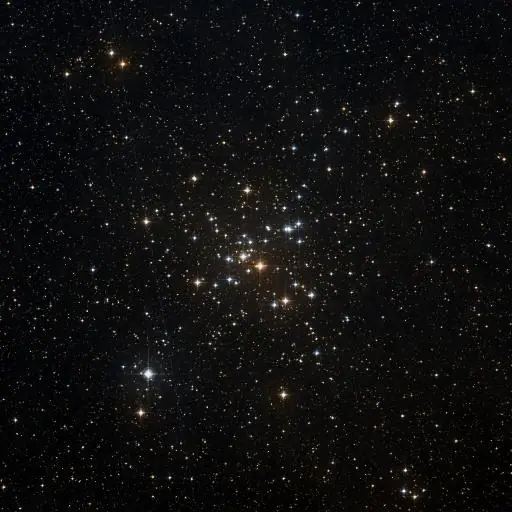
Possibly seen by Aristotle — a star cluster with perhaps 300 million years left before it falls apart.
No open cluster lasts for ever. The roughly 100 stars of M 41 are about 190 million years old, and astronomers estimate the cluster will drift apart by the time it reaches about 500 million. Several of its stars have already reached old age: it contains red giants and white dwarfs, the cooling remains of stars that have died.
Giovanni Hodierna recorded it before 1654. It is sometimes called the Little Beehive, for its resemblance to the Beehive Cluster, M 44. The whole cluster is moving away from us at 23.3 kilometres per second.
M 41 (NGC 2287) is 2,300 light-years away: the light we see from it set off around 280 BC, 165 years after the Parthenon was dedicated in Athens.
Did you know?
- Seen by Aristotle?. M 41 may have been observed by the Greek philosopher Aristotle as early as 325 BC — long before telescopes.
- Curves of stars. Many observers report curved lines of stars in M 41. Walter Scott Houston found they stood out strongly in his 10-inch telescope, though they look inconspicuous in photographs.
How big is it?
Born about 170 million years ago, when dinosaurs were rising and the supercontinent Pangaea was breaking apart. Light itself takes 25 years to cross it. Gaia has picked out 948 stars moving together through space as its members. That’s 6 times the distance from the Sun to the nearest star. Shrink our Solar System — the Sun and all eight planets — to the size of a coin, and M 41 would be 642 m across (6 football pitches end to end); the nearest star would be a football pitch away, and the Milky Way 2,520 km across.
A bright open cluster 4° south of Sirius, visible to the naked eye from dark sites, with a reddish giant star near its center.
When and where to see it
It is best placed in the evening sky around January, when it crosses the meridian at about 10 pm local time (around midnight in January). It can be seen from everywhere south of 69°N and never sets south of 69°S.
At its highest it stands 19° up from 50°N, 34° up from 35°N, 69° up from the equator, 76° up from 35°S.
Facts
- Type
- Open cluster
- Constellation
- Canis Major
- Designations
- NGC 2287, Mel 52, Cr 118, Little Beehive Cluster, Melotte 52, Collinder 118
- Magnitude
- 4.5
- Apparent size
- 38′
- Position
- RA 6h 46.0m, Dec −20° 45′ (J2000)
- Distance
- 2,300 light-years
- Discovered
- Giovanni Battista Hodierna, 1654, Possibly seen by Aristotle around 325 BC
Open AstroPilot to see when M 41 (NGC 2287) is highest tonight from your location, how easy it is with your telescope or binoculars, and an eyepiece view.