M 40 (Winnecke 4)
M 40 (Winnecke 4) is a double star in the constellation Ursa Major, magnitude 9.7.
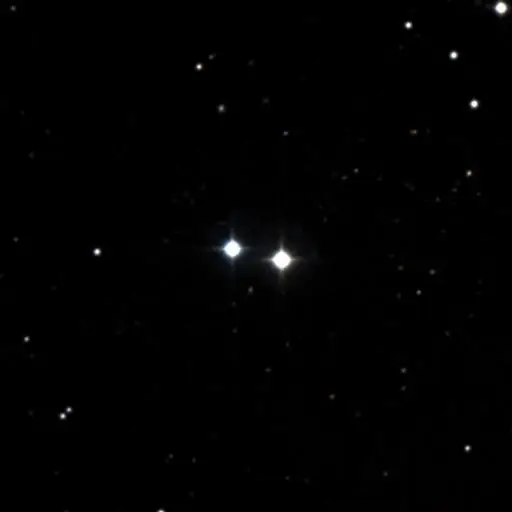
Messier’s mistake: two unrelated stars he logged while hunting for a nebula that wasn’t there.
In 1764 Charles Messier went looking for a nebula that Johannes Hevelius had reported in Ursa Major. He found no nebula — only two faint stars close together — and catalogued them anyway. Robert Burnham Jr. later called M 40 “one of the few real mistakes in the Messier catalog”.
What had Hevelius seen? Probably 74 and 75 Ursae Majoris, a brighter pair a degree to the east that can blur into a single fuzzy star to the naked eye. Why Messier settled on a pair far too faint for the eye is unclear; he may have been pointing out Hevelius’s error. Friedrich Winnecke rediscovered the pair in 1863, and it became number 4 in his catalogue of double stars.
The two are not partners at all, just an optical double star: Gaia shows one is more than twice as far away as the other.
M 40 (Winnecke 4) is 1,000 light-years away: the light we see from it set off around 1030, around the time Chinese astronomers recorded the supernova that made the Crab Nebula.
Did you know?
- Drifting apart. In 1991 the two stars were measured 51.7 arcseconds apart, wider than in Messier’s day — fitting for two stars moving independently rather than orbiting each other.
- A hidden third star. The nearer star, HD 238108, is itself a true binary: it has a faint white dwarf companion, an 18th-magnitude speck just 5 arcseconds away.
How big is it?
4.5 times as wide as the Sun — and 13 times as bright. Its main star is about 6.2 million km across. It has 1.1 times the Sun’s mass. Its companion star is at least 16,000 times Earth’s distance from the Sun away — 542 times as far as Neptune is from the Sun.
Not a nebula or cluster but a pair of unrelated stars, Winnecke 4, which Messier logged while looking for a nebula reported in this area; it stays in the catalogue by tradition. Its components (magnitudes 9.7 and 10.2; spectral types G0 (yellow) and F8 (yellow-white)) lie 53.2″ apart at PA 76° (measured 2017).
When and where to see it
It is best placed in the evening sky around April, when it crosses the meridian at about 10 pm local time (around midnight in March). It can be seen from everywhere north of 32°S and never sets north of 32°N.
At its highest it stands 82° up from 50°N, 67° up from 35°N, 32° up from the equator, below the horizon from 35°S.
Facts
- Type
- Double star
- Constellation
- Ursa Major
- Designations
- Winnecke 4
- Magnitude
- 9.7
- Position
- RA 12h 22.3m, Dec +58° 5′ (J2000)
- Distance
- 1,000 light-years
- Discovered
- Charles Messier, 1764, Rediscovered by Winnecke in 1863
Open AstroPilot to see when M 40 (Winnecke 4) is highest tonight from your location, how easy it is with your telescope or binoculars, and an eyepiece view.