M 39 (NGC 7092)
M 39 (NGC 7092) is an open cluster in the constellation Cygnus, magnitude 4.6, 32′ across.
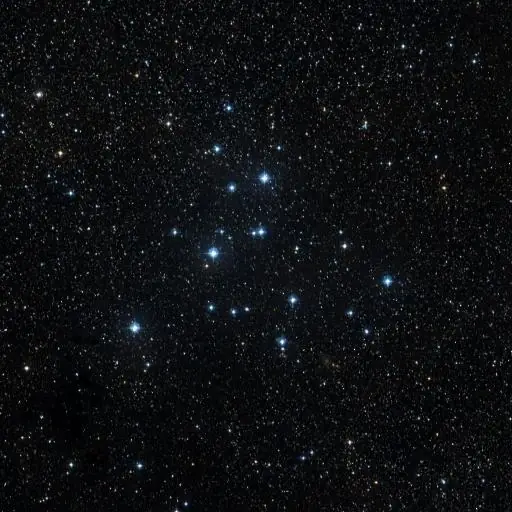
A loose cluster where pairs are common — six of its fifteen brightest stars are binaries.
Guillaume Le Gentil discovered M 39 in 1749, and Charles Messier added it to his catalogue in 1764. It is a loose open cluster holding about 232 times the mass of the Sun.
Look closer and many of its stars turn out to be pairs. Of its 15 brightest members, six are binary systems, and one more is suspected. One of them, HD 205117, is probably an eclipsing binary: every 113.2 days its two stars take turns passing in front of each other. M 39 also holds at least five chemically peculiar stars, with odd amounts of certain elements, and ten suspected short-period variable stars.
M 39 (NGC 7092) is 960 light-years away: the light we see from it set off around 1065, around the time Chinese astronomers recorded the supernova that made the Crab Nebula.
Did you know?
- Subgiants in orbit. Both stars in HD 205117 seem to be subgiants — stars that have run low on hydrogen in their cores and are beginning to swell into giants.
- A gentle dip. The eclipses of HD 205117 dim it by only about 5% — far too little for the eye to notice, but measurable with sensitive instruments.
How big is it?
Born about 400 million years ago, when the first plants and animals were moving onto land. Light itself takes 8.9 years to cross it. Gaia has picked out 511 stars moving together through space as its members. That’s 2.1 times the distance from the Sun to the nearest star. Shrink our Solar System — the Sun and all eight planets — to the size of a coin, and M 39 would be 226 m across (2 football pitches end to end); the nearest star would be a football pitch away, and the Milky Way 2,520 km across.
A large, loose open cluster in Cygnus, best in binoculars or at very low power, where its bright stars form a triangle.
When and where to see it
It is best placed in the evening sky around September, when it crosses the meridian at about 10 pm local time (around midnight in August). It can be seen from everywhere north of 42°S and never sets north of 42°N.
At its highest it stands 88° up from 50°N, 77° up from 35°N, 42° up from the equator, 7° up from 35°S.
Facts
- Type
- Open cluster
- Constellation
- Cygnus
- Designations
- NGC 7092, Pyramid Cluster
- Magnitude
- 4.6
- Apparent size
- 32′
- Position
- RA 21h 31.8m, Dec +48° 26′ (J2000)
- Distance
- 960 light-years
- Discovered
- Guillaume Le Gentil, 1749
Open AstroPilot to see when M 39 (NGC 7092) is highest tonight from your location, how easy it is with your telescope or binoculars, and an eyepiece view.