M 38 (NGC 1912)
M 38 (NGC 1912) is an open cluster in the constellation Auriga, magnitude 7.4, 21′ across.
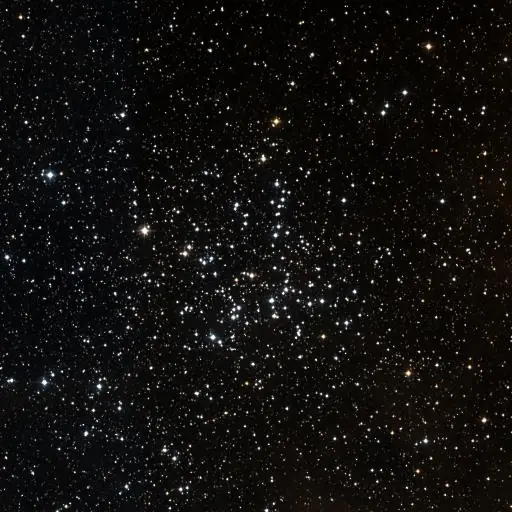
A cluster with a yellow giant as bright as 900 Suns — and a neighbour that’s only passing by.
Giovanni Hodierna found M 38 before 1654, together with its Auriga neighbours M 36 and M 37, and Guillaume Le Gentil found it again in 1749. Observers have long seen shapes in its stars: the Greek letter pi, or, according to Webb, an “oblique cross”.
This open cluster is about 290 million years old and holds roughly 100 stars. The brightest is a yellow giant shining with about 900 times the Sun’s light. Our own Sun, seen from M 38, would be a feeble 15th-magnitude star, visible only in a large telescope.
M 38 (NGC 1912) is 3,500 light-years away: the light we see from it set off around 1480 BC, 150 years before Tutankhamun was buried in the Valley of the Kings.
Did you know?
- Ships passing in the night. The small cluster NGC 1907 appears right beside M 38, but the two were born in different parts of the galaxy. They are most likely just passing each other in a fly-by.
- Patterns that fade. Older reports almost always mention a cross. Yet Walter Scott Houston found that through a 24-inch telescope, the host of stars made any search for a geometric figure fruitless.
How big is it?
Born about 300 million years ago, when the first plants and animals were moving onto land. Light itself takes 21 years to cross it. Gaia has picked out 1,072 stars moving together through space as its members. That’s 5 times the distance from the Sun to the nearest star. Shrink our Solar System — the Sun and all eight planets — to the size of a coin, and M 38 would be 540 m across (5 football pitches end to end); the nearest star would be a football pitch away, and the Milky Way 2,520 km across.
A large open cluster in Auriga whose stars form a cross or starfish pattern; the small cluster NGC 1907 lies just to its south.
When and where to see it
It is best placed in the evening sky around January, when it crosses the meridian at about 10 pm local time (around midnight in December). It can be seen from everywhere north of 54°S and never sets north of 54°N.
At its highest it stands 76° up from 50°N, 89° up from 35°N, 54° up from the equator, 19° up from 35°S.
Facts
- Type
- Open cluster
- Constellation
- Auriga
- Designations
- NGC 1912, Mel 36, Cr 67, Starfish Cluster, Melotte 36, Collinder 67
- Magnitude
- 7.4
- Apparent size
- 21′
- Position
- RA 5h 28.7m, Dec +35° 51′ (J2000)
- Distance
- 3,500 light-years
- Discovered
- Giovanni Battista Hodierna, 1654
Open AstroPilot to see when M 38 (NGC 1912) is highest tonight from your location, how easy it is with your telescope or binoculars, and an eyepiece view.