M 37 (NGC 2099)
M 37 (NGC 2099) is an open cluster in the constellation Auriga, magnitude 6.2, 24′ across.
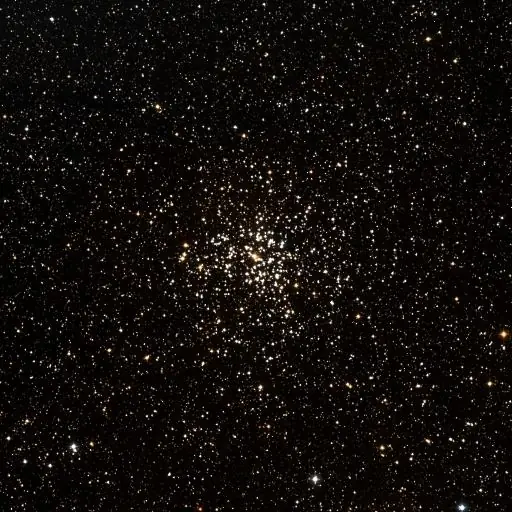
A crowd of 500 stars with a rare guest: one of only three planetary nebulae known in an open cluster.
Giovanni Hodierna recorded M 37 before 1654, along with its neighbours M 36 and M 38. When Guillaume Le Gentil rediscovered those two in 1749 he missed this one, and Charles Messier found it independently in September 1764.
It lies in the opposite direction from the centre of the galaxy, still within our own spiral arm. Its 500-plus stars are somewhere between 347 and 550 million years old, and the heavier ones are already ageing. There are at least a dozen red giants, and its hottest surviving main-sequence stars are of type B9 — hotter, more massive stars have long since burned out. This rich open cluster weighs about 1,500 times as much as the Sun.
M 37 (NGC 2099) is 4,600 light-years away: the light we see from it set off around 2580 BC, around the time the Great Pyramid of Giza was completed.
Did you know?
- A rare planetary nebula. As of 2022, M 37 held only the third planetary nebula known to be associated with an open cluster — the glowing shell of a dying star.
- Round the galaxy. M 37 circles the Milky Way every 219 million years, bobbing gently through the galactic plane every 31.7 million years.
How big is it?
Born about 450 million years ago, when the first plants and animals were moving onto land. Light itself takes 32 years to cross it. Gaia has picked out 2,424 stars moving together through space as its members. That’s 7.6 times the distance from the Sun to the nearest star. Shrink our Solar System — the Sun and all eight planets — to the size of a coin, and M 37 would be 810 m across (8 football pitches end to end); the nearest star would be a football pitch away, and the Milky Way 2,520 km across.
The richest of the Auriga clusters: a dense swarm of hundreds of faint stars with an orange star near its center, beautiful in any telescope.
When and where to see it
It is best placed in the evening sky around January, when it crosses the meridian at about 10 pm local time (around midnight in December). It can be seen from everywhere north of 57°S and never sets north of 57°N.
At its highest it stands 73° up from 50°N, 88° up from 35°N, 57° up from the equator, 22° up from 35°S.
Facts
- Type
- Open cluster
- Constellation
- Auriga
- Designations
- NGC 2099, Mel 38, Cr 75, Salt and Pepper Cluster, Melotte 38, Collinder 75
- Magnitude
- 6.2
- Apparent size
- 24′
- Position
- RA 5h 52.3m, Dec +32° 33′ (J2000)
- Distance
- 4,600 light-years
- Discovered
- Giovanni Battista Hodierna, 1654, Found independently by Messier in 1764
Open AstroPilot to see when M 37 (NGC 2099) is highest tonight from your location, how easy it is with your telescope or binoculars, and an eyepiece view.