M 36 (NGC 1960)
M 36 (NGC 1960) is an open cluster in the constellation Auriga, magnitude 6.3, 12′ across.
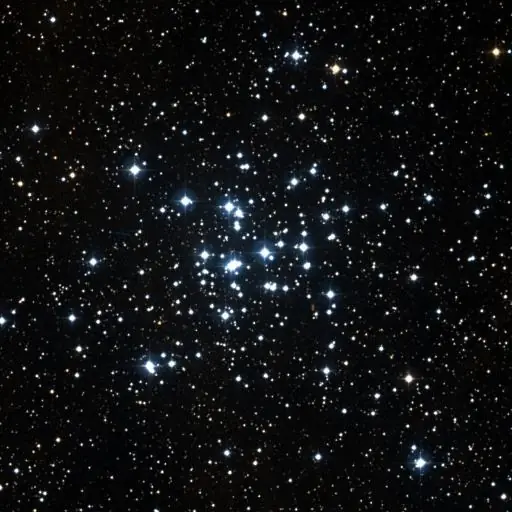
A twin of the Pleiades, seen from much farther away.
Move the Pleiades much farther off and you would see something like M 36. The two clusters are very similar: placed at the same distance, they would shine about equally bright. M 36’s stars are young, about 25 million years old. Which of its stars still hold lithium — a fragile element that stars destroy as they age — points to a matching age of about 22 million years.
Giovanni Hodierna described this open cluster as a nebulous patch before 1654. Guillaume Le Gentil found it again in 1749, and Charles Messier added it to his catalogue in 1764. All told it holds about 746 times the mass of the Sun, with 178 stars down to 14th magnitude.
M 36 (NGC 1960) is 3,700 light-years away: the light we see from it set off around 1680 BC, 350 years before Tutankhamun was buried in the Valley of the Kings.
Did you know?
- Holoea, the flowing gas. A young star with an outflow appears near M 36 and is nicknamed Holoea, Hawaiian for “flowing gas”. It probably lies far behind the cluster, in the star-forming region S235.
- Glowing in the infrared. 38 of M 36’s members give off more infrared light than expected — often a sign of warm dust around a star.
How big is it?
Born about 28 million years ago, when the Himalayas and the Alps were rising. Light itself takes 13 years to cross it. Gaia has picked out 373 stars moving together through space as its members. That’s 3 times the distance from the Sun to the nearest star. Shrink our Solar System — the Sun and all eight planets — to the size of a coin, and M 36 would be 326 m across (3 football pitches end to end); the nearest star would be a football pitch away, and the Milky Way 2,520 km across.
The most compact of the three bright open clusters in Auriga (M36, M37 and M38): a tight group of about 60 young stars.
When and where to see it
It is best placed in the evening sky around January, when it crosses the meridian at about 10 pm local time (around midnight in December). It can be seen from everywhere north of 56°S and never sets north of 56°N.
At its highest it stands 74° up from 50°N, 89° up from 35°N, 56° up from the equator, 21° up from 35°S.
Facts
- Type
- Open cluster
- Constellation
- Auriga
- Designations
- NGC 1960, Mel 37, Cr 71, Pinwheel Cluster, Melotte 37, Collinder 71
- Magnitude
- 6.3
- Apparent size
- 12′
- Position
- RA 5h 36.3m, Dec +34° 8′ (J2000)
- Distance
- 3,700 light-years
- Discovered
- Giovanni Battista Hodierna, 1654
Open AstroPilot to see when M 36 (NGC 1960) is highest tonight from your location, how easy it is with your telescope or binoculars, and an eyepiece view.