M 35 (NGC 2168)
M 35 (NGC 2168) is an open cluster in the constellation Gemini, magnitude 5.3, 28′ across.
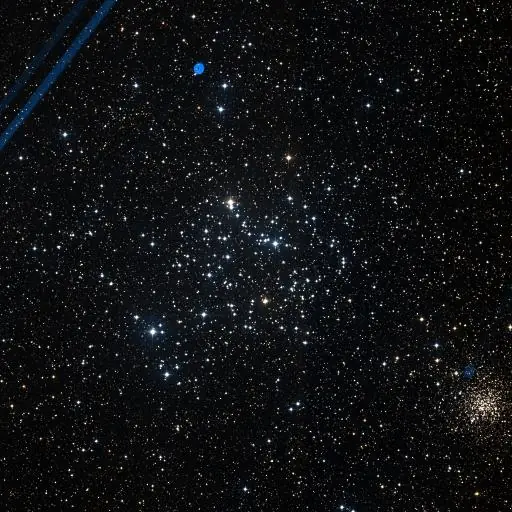
The Shoe-Buckle Cluster: a rich swarm in which more than one star in seven hides a partner.
Philippe Loys de Chéseaux discovered M 35 around 1745, and John Bevis found it again on his own before 1750. Sometimes called the Shoe-Buckle Cluster, it is a big, rich open cluster — and counting its members is surprisingly hard.
Stars are judged by their motions, distances and spectra: 305 are almost certainly members, while as many as 4,349 have at least an even chance of belonging. Its central region alone holds around 1,600 times the mass of the Sun.
Many of its stars come in pairs. A 2015 study of 418 probable members found 64 whose speed towards or away from us keeps shifting back and forth — the sign of an unseen partner tugging them around.
M 35 (NGC 2168) is 2,700 light-years away: the light we see from it set off around 680 BC, around the time the first recorded Olympic Games were held.
Did you know?
- What makes a member?. To belong to a cluster, a star must be held by its gravity — or, if it recently escaped, have been born in the same event as the rest.
- Odd ones out. Four probable members of M 35 are chemically peculiar stars, with unusual amounts of certain elements in their atmospheres. Overall, its stars hold a little less iron than the Sun.
How big is it?
Born about 150 million years ago, when dinosaurs were rising and the supercontinent Pangaea was breaking apart. Light itself takes 22 years to cross it. Gaia has picked out 1,609 stars moving together through space as its members. That’s 5.2 times the distance from the Sun to the nearest star. Shrink our Solar System — the Sun and all eight planets — to the size of a coin, and M 35 would be 555 m across (5 football pitches end to end); the nearest star would be a football pitch away, and the Milky Way 2,520 km across.
A large, rich open cluster at the feet of Gemini, visible to the naked eye from dark sites. The small, much more distant cluster NGC 2158 shares the low-power field.
When and where to see it
It is best placed in the evening sky around January, when it crosses the meridian at about 10 pm local time (around midnight in December). It can be seen from everywhere north of 66°S and never sets north of 66°N.
At its highest it stands 64° up from 50°N, 79° up from 35°N, 66° up from the equator, 31° up from 35°S.
Facts
- Type
- Open cluster
- Constellation
- Gemini
- Designations
- NGC 2168, Mel 41, Cr 82, Shoe-Buckle Cluster, Melotte 41, Collinder 82
- Magnitude
- 5.3
- Apparent size
- 28′
- Position
- RA 6h 9.1m, Dec +24° 20′ (J2000)
- Distance
- 2,700 light-years
- Discovered
- Philippe Loys de Chéseaux, 1745, Found independently by John Bevis before 1750
Open AstroPilot to see when M 35 (NGC 2168) is highest tonight from your location, how easy it is with your telescope or binoculars, and an eyepiece view.