M 34 (NGC 1039)
M 34 (NGC 1039) is an open cluster in the constellation Perseus, magnitude 5.5, 35′ across.
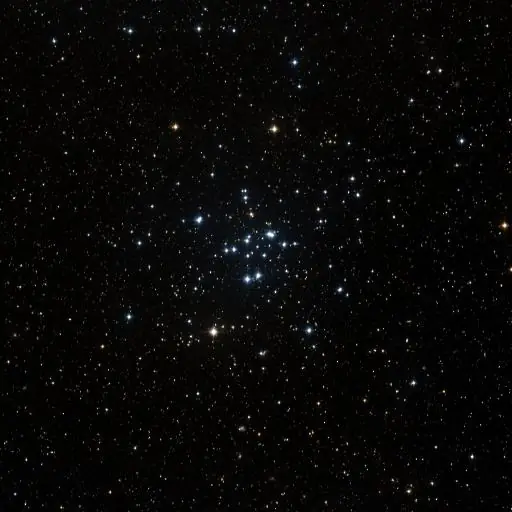
A middle-aged star cluster, with at least 19 burnt-out stars among its members.
Giovanni Hodierna probably found this open cluster before 1654, and Charles Messier added it to his list in 1764, noting that a 3-foot telescope would separate its stars. It holds about 400 stars of between a tenth and one solar mass.
At 200–250 million years old, M 34 sits between the youthful Pleiades and the older Hyades. That is about how long a star of half the Sun’s mass takes to settle into steady hydrogen burning on the main sequence; a star like the Sun gets there in just 30 million years.
Its heaviest stars have already died. At least 19 members are white dwarfs — the cooling remains of stars of up to eight times the Sun’s mass, with no nuclear fusion left to keep them shining.
M 34 (NGC 1039) is 1,600 light-years away: the light we see from it set off around AD 430, 110 years before the Hagia Sophia was completed in Constantinople.
Did you know?
- A dash of extra iron. M 34’s stars contain about 17% more iron, relative to hydrogen, than the Sun does — though they are short of nickel.
- Clues from the dead. White dwarfs in a cluster of known age help astronomers work out how massive a star can be and still end its life quietly, rather than exploding as a supernova.
How big is it?
Born about 130 million years ago, when dinosaurs still walked the Earth. Light itself takes 16 years to cross it. Gaia has picked out 1,095 stars moving together through space as its members. That’s 3.8 times the distance from the Sun to the nearest star. Shrink our Solar System — the Sun and all eight planets — to the size of a coin, and M 34 would be 411 m across (4 football pitches end to end); the nearest star would be a football pitch away, and the Milky Way 2,520 km across.
A bright, scattered open cluster in Perseus, easy in binoculars and lovely at low power.
When and where to see it
It is best placed in the evening sky around December, when it crosses the meridian at about 10 pm local time (around midnight in November). It can be seen from everywhere north of 47°S and never sets north of 47°N.
At its highest it stands 83° up from 50°N, 82° up from 35°N, 47° up from the equator, 12° up from 35°S.
Facts
- Type
- Open cluster
- Constellation
- Perseus
- Designations
- NGC 1039, Mel 17, Cr 31, Spiral Cluster, Melotte 17, Collinder 31
- Magnitude
- 5.5
- Apparent size
- 35′
- Position
- RA 2h 42.1m, Dec +42° 45′ (J2000)
- Distance
- 1,600 light-years
- Discovered
- Giovanni Battista Hodierna, 1654, Probably found before 1654
Open AstroPilot to see when M 34 (NGC 1039) is highest tonight from your location, how easy it is with your telescope or binoculars, and an eyepiece view.