Triangulum Galaxy (M 33)
Triangulum Galaxy (M 33) is a galaxy in the constellation Triangulum, magnitude 5.7, 1.0° × 37′ across.
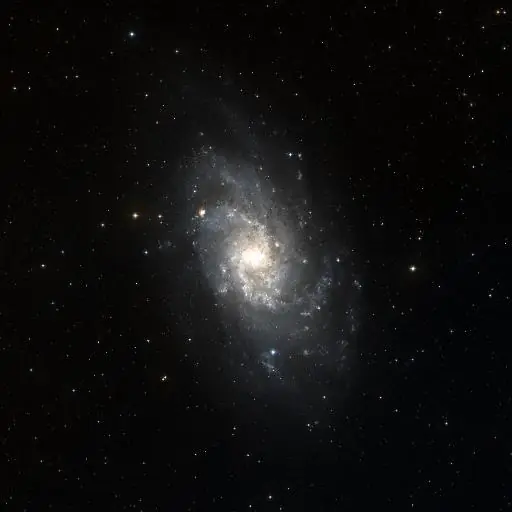
A whole spiral galaxy that keen eyes can see without a telescope — farther away than Andromeda.
Under a very dark sky, some people can pick out M 33 with the naked eye: a faint smudge that is a whole spiral galaxy of perhaps 40 billion stars. It is the most distant permanent object visible without optical aid, and one of the reference objects of the bortle scale used to rate dark skies.
Giovanni Hodierna probably recorded it before 1654, as a cloud “near the Triangle”. Charles Messier found it independently on the night of 25–26 August 1764. William Herschel, who generally left Messier’s objects out of his own catalogue, made an exception for this one in 1784, and in 1850 Lord Rosse identified it as one of the first “spiral nebulae”.
In 1926 Edwin Hubble showed that 35 of its variable stars were Cepheids, helping prove that spiral nebulae are independent galaxies. M 33 is the third-largest member of the Local Group, after Andromeda and the Milky Way, and may be a satellite of Andromeda.
Triangulum Galaxy (M 33) is 2.7 million light-years away: the light we see from it set off about 2.7 million years ago, when our distant ancestors were making the first stone tools.
Did you know?
- Not the Pinwheel. Some books and telescope software call M 33 the Pinwheel Galaxy, but professional databases reserve that name for M 101 in Ursa Major.
- A bridge of gas. A clumpy stream of hydrogen gas links M 33 with the Andromeda Galaxy, announced in 2004 and confirmed in 2011. The two may have interacted in the past.
- A giant star nursery. NGC 604, M 33’s brightest star-forming cloud, is one of the largest such regions known, with a spectrum like the Orion Nebula’s. William Herschel catalogued it separately from the galaxy.
- Tracked by its water. In 2005, radio astronomers followed two water masers — natural microwave lasers — on opposite sides of M 33, measuring its rotation and motion across the sky for the first time.
How big is it?
49% of the Milky Way’s width. Light itself takes 49,000 years to cross it. Shrink it to the length of a football pitch and our whole Solar System would be smaller than a bacterium. It holds about 40 billion stars — the Milky Way has a few hundred billion. All told — stars, gas and dark matter — it weighs about 400 billion Suns.
The third-largest galaxy of the Local Group, a face-on spiral about twice the width of the full Moon. Its light is spread thin, so it needs dark skies and low power; then its arms and the bright star-forming region NGC 604 appear.
When and where to see it
It is best placed in the evening sky around November, when it crosses the meridian at about 10 pm local time (around midnight in October). It can be seen from everywhere north of 59°S and never sets north of 59°N.
At its highest it stands 71° up from 50°N, 86° up from 35°N, 59° up from the equator, 24° up from 35°S.
Facts
- Type
- Galaxy
- Constellation
- Triangulum
- Designations
- M 33, NGC 598, Triangulum Pinwheel
- Magnitude
- 5.7
- Apparent size
- 1.0° × 37′
- Position
- RA 1h 33.8m, Dec +30° 40′ (J2000)
- Distance
- 2.7 million light-years
- Discovered
- Giovanni Battista Hodierna, 1654, Probably recorded before 1654; found again by Messier in 1764
Open AstroPilot to see when Triangulum Galaxy (M 33) is highest tonight from your location, how easy it is with your telescope or binoculars, and an eyepiece view.