M 32 (NGC 221)
M 32 (NGC 221) is a galaxy in the constellation Andromeda, magnitude 8.1, 7.7′ × 4.9′ across.
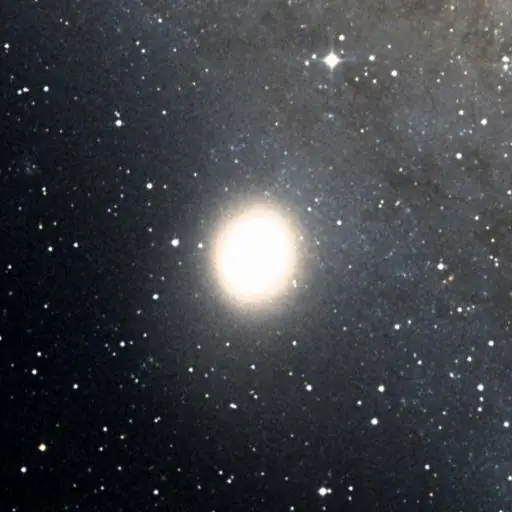
Andromeda’s compact little companion — perhaps all that remains of a once-great spiral galaxy.
M 32 is a satellite of the Andromeda Galaxy, discovered by Guillaume Le Gentil in 1749. It is the prototype of a rare class, the compact elliptical galaxy. Half its stars crowd into its inner core — mostly old red and yellow stars, with almost no gas or dust left to make new ones, although there are hints of star formation in the fairly recent past.
How did it get so compact? One idea is that it was once a disc galaxy whose outer layers were stripped away by Andromeda’s gravity, leaving only its dense centre. A bolder one says M 32 is the core of a lost galaxy, M32p — once the third-largest in the Local Group — that merged with Andromeda about two billion years ago. Others argue it was simply born compact. The puzzle remains open.
M 32 (NGC 221) is 2.6 million light-years away: the light we see from it set off about 2.6 million years ago, when our distant ancestors were making the first stone tools.
Did you know?
- A black hole at the heart. M 32 holds a supermassive black hole of about 1.5 to 5 million Suns. A faint radio and X-ray source at its centre, called M32*, comes from gas falling onto it.
- In front, not behind. M 32 lies in front of Andromeda, not behind it: its stars are not reddened by Andromeda’s dust. In 2000, a star in M 32 even briefly magnified a star in Andromeda by gravitational microlensing.
How big is it?
A dwarf beside the Milky Way. Light itself takes 5,850 years to cross it. Shrink it to the length of a football pitch and our whole Solar System would be thinner than a human hair.
A small, bright elliptical satellite of the Andromeda Galaxy that looks like a fuzzy star just south of M31's core.
When and where to see it
It is best placed in the evening sky around November, when it crosses the meridian at about 10 pm local time (around midnight in October). It can be seen from everywhere north of 49°S and never sets north of 49°N.
At its highest it stands 81° up from 50°N, 84° up from 35°N, 49° up from the equator, 14° up from 35°S.
Facts
- Type
- Galaxy
- Constellation
- Andromeda
- Designations
- NGC 221
- Magnitude
- 8.1
- Apparent size
- 7.7′ × 4.9′
- Position
- RA 0h 42.7m, Dec +40° 52′ (J2000)
- Distance
- 2.6 million light-years
- Discovered
- Guillaume Le Gentil, 1749
Open AstroPilot to see when M 32 (NGC 221) is highest tonight from your location, how easy it is with your telescope or binoculars, and an eyepiece view.