Andromeda Galaxy (M 31)
Andromeda Galaxy (M 31) is a galaxy in the constellation Andromeda, magnitude 3.4, 3.0° × 1.2° across.
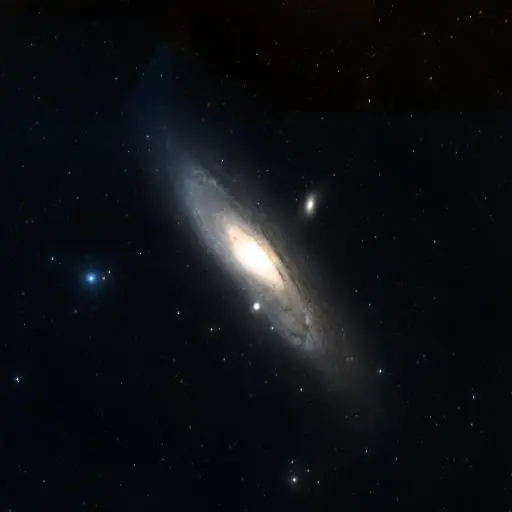
The galaxy that proved the universe is bigger than the Milky Way — and may one day merge with it.
Around AD 964, the Persian astronomer al-Sufi described a “small cloud” in Andromeda in his Book of Fixed Stars. It is the earliest known record of a galaxy beyond our own — though for nearly a thousand years, no one knew that is what it was.
Was it a cloud of gas inside the Milky Way, or an “island universe” of its own? Immanuel Kant suspected the latter in 1755. In 1864 William Huggins found that its light looked like starlight, not glowing gas, and in 1920 Harlow Shapley and Heber Curtis argued the question in the Great Debate. Then in 1925 Edwin Hubble found Cepheid variable stars in it, measured its distance and settled the matter: Andromeda is a separate galaxy, and ours is just one of many.
It is a barred spiral galaxy with a mass similar to the Milky Way’s, and the largest galaxy of the Local Group. The two have about a 50% chance of colliding within the next 10 billion years, perhaps merging into one giant elliptical galaxy.
Andromeda Galaxy (M 31) is 2.5 million light-years away: the light we see from it set off about 2.5 million years ago, when our distant ancestors were making the first stone tools.
Did you know?
- The supernova of 1885. In 1885 a “nova” flared in Andromeda. No one realised it was a supernova, far brighter than an ordinary nova. S Andromedae remains the only supernova ever seen there.
- Where star populations got their names. In 1943 Walter Baade resolved stars in Andromeda’s core and sorted them into two populations, young and old. His labels are now used for stars in the Milky Way and beyond.
- Record speed. In 1912 Vesto Slipher measured Andromeda’s speed relative to the Solar System: about 300 kilometres per second, the largest velocity measured up to then.
- Credit where it wasn’t due. Charles Messier catalogued it in 1764 but credited Simon Marius, who had described it through a telescope in 1612 — even though it is visible to the naked eye.
How big is it?
1.3 times as wide as our Milky Way. Light itself takes 130,000 years to cross it. Shrink it to the length of a football pitch and our whole Solar System would be smaller than a bacterium. It holds about 1 trillion stars — the Milky Way has a few hundred billion. All told — stars, gas and dark matter — it weighs about 1.5 trillion Suns.
The nearest large spiral galaxy, about 2.5 million light-years away and the most distant object easy to see with the naked eye. Binoculars show its long, bright core; telescopes add its companions M32 and M110 and, under dark skies, a dust lane.
When and where to see it
It is best placed in the evening sky around November, when it crosses the meridian at about 10 pm local time (around midnight in October). It can be seen from everywhere north of 49°S and never sets north of 49°N.
At its highest it stands 81° up from 50°N, 84° up from 35°N, 49° up from the equator, 14° up from 35°S.
Facts
- Type
- Galaxy
- Constellation
- Andromeda
- Designations
- M 31, NGC 224
- Magnitude
- 3.4
- Apparent size
- 3.0° × 1.2°
- Position
- RA 0h 42.7m, Dec +41° 16′ (J2000)
- Distance
- 2.5 million light-years
- Discovered
- Abd al-Rahman al-Sufi, 964, Earliest known record, around AD 964; visible to the naked eye
Open AstroPilot to see when Andromeda Galaxy (M 31) is highest tonight from your location, how easy it is with your telescope or binoculars, and an eyepiece view.