M 29 (NGC 6913)
M 29 (NGC 6913) is an open cluster in the constellation Cygnus, magnitude 7.1, 7.0′ across.
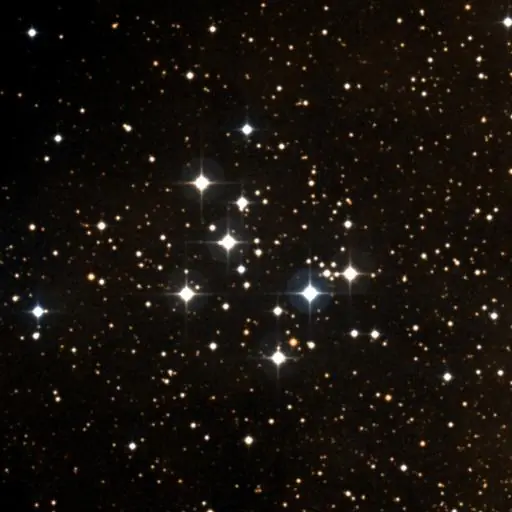
A young cluster of hot blue giants, half-hidden by the dust of our own spiral arm.
The brightest stars of M 29 are blue giants of spectral class B0 — very hot, very young stars that put the cluster’s age at only about 10 million years. Together it shines with about 160,000 times the Sun’s light, though much of that is dimmed by dust and faint nebulosity before it reaches us.
Charles Messier found this open cluster in 1764. It belongs to Cygnus OB1, a loose association of young, hot stars, and it is moving towards us at about 28 kilometres per second. Its distance is hard to pin down, because the dust of our local spiral arm, the Orion–Cygnus Arm, makes it difficult to tell how much of its light has been lost.
M 29 (NGC 6913) is 5,600 light-years away: the light we see from it set off around 3580 BC, 370 years before writing was invented in Mesopotamia.
Did you know?
- Why the Cooling Tower?. Its four brightest stars form a squat quadrilateral that reminded observers of the curved, hyperboloid cooling towers of power stations.
- A fierce neighbour. Near the cluster lies WR 143, an especially hot Wolf–Rayet star in a binary — a massive star stripping itself bare in a powerful wind.
- How many members?. Counts vary: an early estimate gave M 29 about 20 member stars, while the Sky Catalogue lists 50.
How big is it?
Born about 6.9 million years ago, when our ancestors and the chimpanzees' were going their separate ways. Light itself takes 11 years to cross it. Gaia has picked out 70 stars moving together through space as its members. That’s 2.7 times the distance from the Sun to the nearest star. Shrink our Solar System — the Sun and all eight planets — to the size of a coin, and M 29 would be 288 m across (3 football pitches end to end); the nearest star would be a football pitch away, and the Milky Way 2,520 km across.
A small open cluster in Cygnus whose brightest stars form a squat box, nicknamed the Cooling Tower; it lies less than 2° south of Gamma Cygni (Sadr) in a rich Milky Way field.
When and where to see it
It is best placed in the evening sky around August, when it crosses the meridian at about 10 pm local time (around midnight in July). It can be seen from everywhere north of 51°S and never sets north of 51°N.
At its highest it stands 79° up from 50°N, 86° up from 35°N, 51° up from the equator, 16° up from 35°S.
Facts
- Type
- Open cluster
- Constellation
- Cygnus
- Designations
- NGC 6913, Cooling Tower Cluster
- Magnitude
- 7.1
- Apparent size
- 7.0′
- Position
- RA 20h 24.0m, Dec +38° 30′ (J2000)
- Distance
- 5,600 light-years
- Discovered
- Charles Messier, 1764
Open AstroPilot to see when M 29 (NGC 6913) is highest tonight from your location, how easy it is with your telescope or binoculars, and an eyepiece view.