Dumbbell Nebula (M 27)
Dumbbell Nebula (M 27) is a planetary nebula in the constellation Vulpecula, magnitude 7.4, 8.0′ × 5.7′ across.
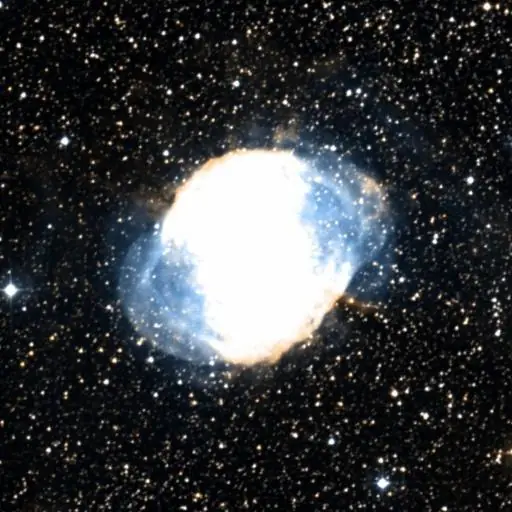
The first planetary nebula ever discovered — the cast-off breath of a dying star.
When Charles Messier came across M 27 in 1764, he had found a new kind of object. It was the first planetary nebula ever discovered: the outer layers of a dying star, puffed off into space and lit up by the hot core left behind.
That core is becoming a white dwarf. It holds a little over half the Sun’s mass, yet it is larger than most known white dwarfs. The shell around it is expanding at about 31 kilometres per second, which suggests the star began shedding it roughly 10,000 years ago.
Near the centre, the gas is full of dark and bright knots trailing comet-like tails, like those found in the Helix and Eskimo nebulae. Their bright tips mark where the star’s ultraviolet light is eating into them.
Dumbbell Nebula (M 27) is 1,200 light-years away: the light we see from it set off around AD 830, around the time Charlemagne was crowned emperor.
Did you know?
- Seen from the side. The nebula is really shaped like a stretched-out ball, and we see it side-on, looking across its equator — part of why it can look like a dumbbell, or an apple core.
- An upper age limit. M 27 grows on the sky by no more than 2.3 arcseconds per century. From that slow creep, astronomers worked out it can be no older than about 14,600 years.
How big is it?
2,940 Solar Systems side by side. Light itself takes 2.8 years to cross it. Shrink our Solar System — the Sun and all eight planets — to the size of a coin, and the Dumbbell Nebula would be 70.5 m across (about the length of a football pitch); the nearest star would be a football pitch away, and the Milky Way 2,520 km across.
One of the brightest planetary nebulae, easy in binoculars as a small glowing patch. Telescopes show its 'apple core' or hourglass shape, and an OIII filter reveals the fainter wings that round it into a football.
When and where to see it
It is best placed in the evening sky around August, when it crosses the meridian at about 10 pm local time (around midnight in July). It can be seen from everywhere north of 67°S and never sets north of 67°N.
At its highest it stands 63° up from 50°N, 78° up from 35°N, 67° up from the equator, 32° up from 35°S.
Facts
- Type
- Planetary nebula
- Constellation
- Vulpecula
- Designations
- M 27, NGC 6853
- Magnitude
- 7.4
- Apparent size
- 8.0′ × 5.7′
- Position
- RA 19h 59.6m, Dec +22° 43′ (J2000)
- Distance
- 1,200 light-years
- Discovered
- Charles Messier, 1764
Open AstroPilot to see when Dumbbell Nebula (M 27) is highest tonight from your location, how easy it is with your telescope or binoculars, and an eyepiece view.