Small Sagittarius Star Cloud (M 24)
Small Sagittarius Star Cloud (M 24) is a star cloud in the constellation Sagittarius, magnitude 2.5, 2.0° × 1.0° across.
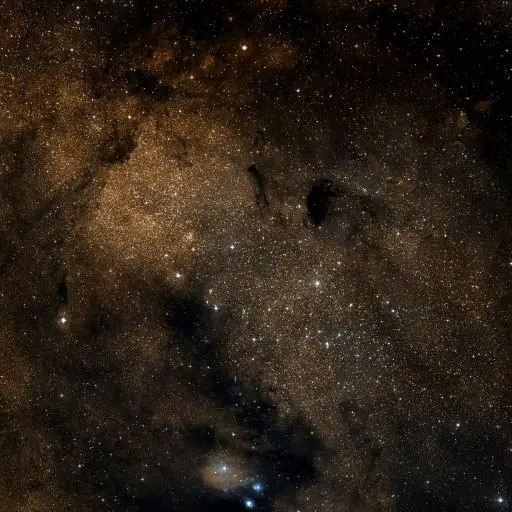
Not an object at all, but a window — a gap in the dust that opens a view deep into the Milky Way.
M 24 is not a cluster or a nebula. It is a window. Here a gap in the Great Rift — the dark lanes of dust that split the milky way — lets us look deep into our galaxy, through the crowded stars of the Scutum–Centaurus Arm, the major spiral arm between us and the galactic centre. It is a star cloud: countless suns at many depths, blended into one glow.
Charles Messier catalogued it in 1764 as “a large nebulosity in which there are many stars of different magnitudes”. Some sources have wrongly identified M 24 with the small cluster NGC 6603 inside it.
Clouds of dust are woven through the star field. Barnard 92, the darker of the two largest, looks like a round hole empty of stars; E. E. Barnard discovered it in 1913.
Small Sagittarius Star Cloud (M 24) is 10,000 light-years away: the light we see from it set off around 7980 BC, 1,530 years after the stone pillars of Göbekli Tepe, the oldest known temple, were raised.
Did you know?
- A twin in Andromeda. M 24 has a counterpart in the Andromeda Galaxy: NGC 206, a large, bright star cloud in our neighbour’s disc.
- Hidden dying stars. Among its crowded stars lie two planetary nebulae, M 1-43 and NGC 6567 — glowing shells cast off by dying stars.
- A spotted, spinning star. Its brightest star, HD 167356, is a white supergiant whose brightness changes slightly as it rotates — an Alpha-2 Canum Venaticorum variable.
How big is it?
82 times the distance from the Sun to the nearest star. Light itself takes 349 years to cross it. Shrink our Solar System — the Sun and all eight planets — to the size of a coin, and the Small Sagittarius Star Cloud would be 8.81 km across (a 2-hour walk); the nearest star would be a football pitch away, and the Milky Way 2,520 km across.
A bright patch of the Milky Way about 2° long, seen through a window in the dust onto stars thousands of light-years beyond. Sweep it with binoculars; it also contains the small cluster NGC 6603 and dark nebulae such as Barnard 92 and 93.
When and where to see it
It is best placed in the evening sky around July, when it crosses the meridian at about 10 pm local time (around midnight in June). It can be seen from everywhere south of 71°N and never sets south of 71°S.
At its highest it stands 21° up from 50°N, 36° up from 35°N, 71° up from the equator, 74° up from 35°S.
Facts
- Type
- Star cloud
- Constellation
- Sagittarius
- Designations
- M 24, IC 4715
- Magnitude
- 2.5
- Apparent size
- 2.0° × 1.0°
- Position
- RA 18h 16.9m, Dec −18° 31′ (J2000)
- Distance
- 10,000 light-years
- Discovered
- Charles Messier, 1764
Open AstroPilot to see when Small Sagittarius Star Cloud (M 24) is highest tonight from your location, how easy it is with your telescope or binoculars, and an eyepiece view.