M 23 (NGC 6494)
M 23 (NGC 6494) is an open cluster in the constellation Sagittarius, magnitude 5.5, 27′ across.
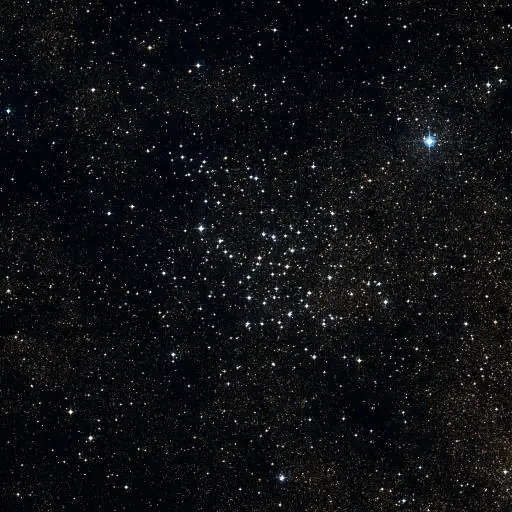
A rich, 330-million-year-old cluster that the Moon can pass in front of.
Charles Messier found this open cluster in 1764. Its stars are about 330 million years old and share almost exactly the Sun’s chemical make-up. Counts of its members range from 169 to 414, together weighing around 1,200 times the mass of the Sun.
Age is starting to show. Five members are candidate red giants — stars that have used up the hydrogen in their cores and swollen up. The orange variable VV Sagittarii may already be on the asymptotic giant branch, one of the last stages in a star’s life before it sheds its outer layers.
M 23 (NGC 6494) is 2,300 light-years away: the light we see from it set off around 280 BC, 165 years after the Parthenon was dedicated in Athens.
Did you know?
- Hidden by the Moon. M 23 lies within 5 degrees of the Sun’s yearly path across the sky, so the Moon can pass in front of it and hide its stars one by one.
- A foreground interloper. A 6th-magnitude star at the cluster’s north-western edge, HD 163245, is not a member at all. It lies far in the foreground, much closer to us than M 23.
How big is it?
Born about 380 million years ago, when the first plants and animals were moving onto land. Light itself takes 18 years to cross it. Gaia has picked out 1,128 stars moving together through space as its members. That’s 4.3 times the distance from the Sun to the nearest star. Shrink our Solar System — the Sun and all eight planets — to the size of a coin, and M 23 would be 456 m across (4 football pitches end to end); the nearest star would be a football pitch away, and the Milky Way 2,520 km across.
A rich, scattered open cluster of about 150 stars in a busy Milky Way field, a fine sight in binoculars or at low power.
When and where to see it
It is best placed in the evening sky around July, when it crosses the meridian at about 10 pm local time (around midnight in June). It can be seen from everywhere south of 71°N and never sets south of 71°S.
At its highest it stands 21° up from 50°N, 36° up from 35°N, 71° up from the equator, 74° up from 35°S.
Facts
- Type
- Open cluster
- Constellation
- Sagittarius
- Designations
- NGC 6494, Mel 184, Cr 356, Melotte 184, Collinder 356
- Magnitude
- 5.5
- Apparent size
- 27′
- Position
- RA 17h 57.1m, Dec −18° 59′ (J2000)
- Distance
- 2,300 light-years
- Discovered
- Charles Messier, 1764
Open AstroPilot to see when M 23 (NGC 6494) is highest tonight from your location, how easy it is with your telescope or binoculars, and an eyepiece view.