M 21 (NGC 6531)
M 21 (NGC 6531) is an open cluster in the constellation Sagittarius, magnitude 6.5, 13′ across.
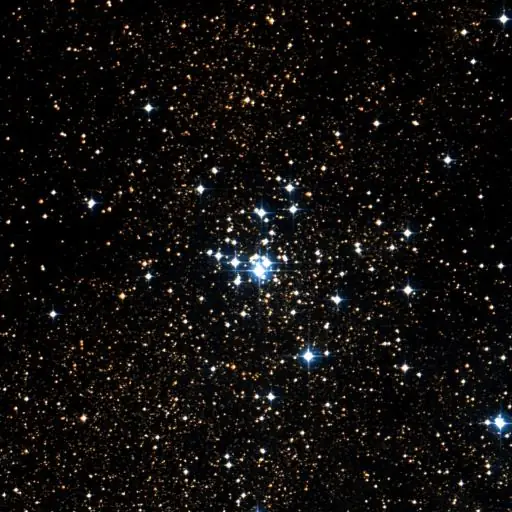
A cluster of stars that seem to have been born all at once, about 6.6 million years ago.
The stars of M 21 are about 6.6 million years old, born long before the first humans walked the Earth but very recently by cosmic standards. They show no real spread in age, which suggests that a single trigger set off the whole cluster’s birth at once.
Charles Messier discovered and catalogued it on 5 June 1764. It lies near the Trifid Nebula in our sky but is not connected to it; instead it belongs to Sagittarius OB1, a loose family of hot young stars. Some of its smaller members are so young that they are still contracting and have not yet settled into steady hydrogen burning.
M 21 (NGC 6531) is 3,900 light-years away: the light we see from it set off around 1880 BC, 550 years before Tutankhamun was buried in the Valley of the Kings.
Did you know?
- Fingerprints of youth. Astronomers picked out 26 likely baby stars in M 21 from two clues in their light: glowing hydrogen and lithium. Stars destroy their lithium as they age, so finding it is a sign of youth.
- Mostly small stars. Despite a few blue giants, M 21 is made mainly of small, dim stars — at least 105 members, together weighing nearly 800 times as much as the Sun.
How big is it?
Born about 13 million years ago, when great apes were spreading through Africa and Europe. Light itself takes 15 years to cross it. Gaia has picked out 212 stars moving together through space as its members. That’s 3.5 times the distance from the Sun to the nearest star. Shrink our Solar System — the Sun and all eight planets — to the size of a coin, and M 21 would be 372 m across (4 football pitches end to end); the nearest star would be a football pitch away, and the Milky Way 2,520 km across.
A compact, young open cluster just northeast of the Trifid Nebula (M20); the two share a low-power field.
When and where to see it
It is best placed in the evening sky around July, when it crosses the meridian at about 10 pm local time (around midnight in June). It can be seen from everywhere south of 68°N and never sets south of 68°S.
At its highest it stands 18° up from 50°N, 33° up from 35°N, 68° up from the equator, 77° up from 35°S.
Facts
- Type
- Open cluster
- Constellation
- Sagittarius
- Designations
- NGC 6531, Webb's Cross Cluster
- Magnitude
- 6.5
- Apparent size
- 13′
- Position
- RA 18h 4.2m, Dec −22° 29′ (J2000)
- Distance
- 3,900 light-years
- Discovered
- Charles Messier, 1764
Open AstroPilot to see when M 21 (NGC 6531) is highest tonight from your location, how easy it is with your telescope or binoculars, and an eyepiece view.