Trifid Nebula (M 20)
Trifid Nebula (M 20) is an emission nebula in the constellation Sagittarius, magnitude 6.3, 28′ across.
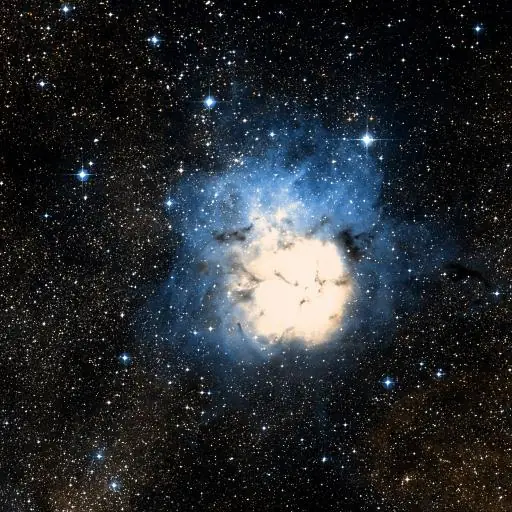
Four objects in one: a glowing cloud, a blue mist, dark dust lanes and a cluster of newborn stars.
The Trifid is four things at once. A pink emission nebula glows as hot young stars light up its hydrogen. A blue reflection nebula shines with scattered starlight. Dark dust lanes, catalogued as Barnard 85, split it into three lobes — the name means “three-lobed”. And at its heart sits a cluster of about 3,100 young stars.
Charles Messier found it on 5 June 1764. Its most massive star, HD 164492A, has more than 20 times the Sun’s mass, and its radiation powers the whole nebula.
In 1997 Hubble zoomed in on a dense cloud nearby — a nursery full of embryonic stars. A jet of gas shoots from a young star hidden inside, glowing in the central star’s light. Beside it, a finger-like stalk points straight at that star: its dense tip has resisted being eaten away by the radiation.
Trifid Nebula (M 20) is 4,000 light-years away: the light we see from it set off around 1980 BC, 590 years after the Great Pyramid of Giza was completed.
Did you know?
- Hidden newborns. In 2005 NASA’s Spitzer Space Telescope, looking in infrared, found 30 embryonic stars and 120 newborn stars in the Trifid that do not show up in visible-light images.
- Exhaust of starbirth. Jets like the one Hubble found are the exhaust of star formation: gas blasted out as a young star grows, made to glow here by radiation from the nebula’s central star.
How big is it?
7.7 times the distance from the Sun to the nearest star. Light itself takes 33 years to cross it. Shrink our Solar System — the Sun and all eight planets — to the size of a coin, and the Trifid Nebula would be 822 m across (8 football pitches end to end); the nearest star would be a football pitch away, and the Milky Way 2,520 km across.
A young star-forming nebula split into three lobes by dark dust lanes, with a blue reflection nebula to its north. A UHC filter helps the red emission part but dims the blue reflection lobe, which is best seen unfiltered.
When and where to see it
It is best placed in the evening sky around July, when it crosses the meridian at about 10 pm local time (around midnight in June). It can be seen from everywhere south of 67°N and never sets south of 67°S.
At its highest it stands 17° up from 50°N, 32° up from 35°N, 67° up from the equator, 78° up from 35°S.
Facts
- Type
- Emission nebula
- Constellation
- Sagittarius
- Designations
- M 20, NGC 6514
- Magnitude
- 6.3
- Apparent size
- 28′
- Position
- RA 18h 2.7m, Dec −22° 58′ (J2000)
- Distance
- 4,000 light-years
- Discovered
- Charles Messier, 1764
Open AstroPilot to see when Trifid Nebula (M 20) is highest tonight from your location, how easy it is with your telescope or binoculars, and an eyepiece view.