M 18 (NGC 6613)
M 18 (NGC 6613) is an open cluster in the constellation Sagittarius, magnitude 7.5, 9.0′ across.
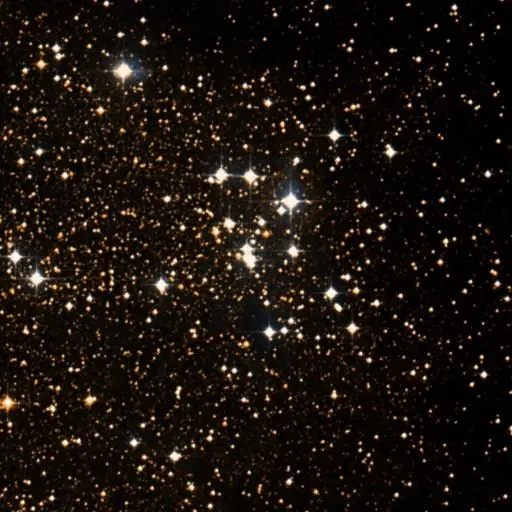
A small family of hot young stars, nicknamed the Black Swan Cluster.
Charles Messier found this little open cluster in 1764 and added it to his list of comet-like objects. At about 33 million years old it is young: its stars include 29 hot B-type stars, one of them a definite Be star — a fast-spinning star that sheds a disc of gas — and three supergiants.
M 18 takes about 186.5 million years to circle the Milky Way, on an almost perfectly round orbit. As it travels it bobs gently up and down, crossing the galaxy’s midplane once every 27.4 million years. All told, it holds about 188 times the mass of the Sun.
M 18 (NGC 6613) is 4,900 light-years away: the light we see from it set off around 2880 BC, around the time the first circle of Stonehenge was raised.
Did you know?
- Skipped by Hubble. As of 2022, M 18 was one of the few Messier objects that the Hubble Space Telescope had never photographed.
- A swelling giant. Its brightest member, HD 168352, is a B-type giant: a hot, blue-white star that has begun to swell as it ages.
How big is it?
Born about 18 million years ago, when great apes were spreading through Africa and Europe. Light itself takes 13 years to cross it. Gaia has picked out 173 stars moving together through space as its members. That’s 3 times the distance from the Sun to the nearest star. Shrink our Solar System — the Sun and all eight planets — to the size of a coin, and M 18 would be 324 m across (3 football pitches end to end); the nearest star would be a football pitch away, and the Milky Way 2,520 km across.
A small, sparse open cluster of a couple of dozen stars, lying between the Omega Nebula (M17) and the Small Sagittarius Star Cloud (M24).
When and where to see it
It is best placed in the evening sky around July, when it crosses the meridian at about 10 pm local time (around midnight in June). It can be seen from everywhere south of 73°N and never sets south of 73°S.
At its highest it stands 23° up from 50°N, 38° up from 35°N, 73° up from the equator, 72° up from 35°S.
Facts
- Type
- Open cluster
- Constellation
- Sagittarius
- Designations
- NGC 6613, Black Swan Cluster
- Magnitude
- 7.5
- Apparent size
- 9.0′
- Position
- RA 18h 20.0m, Dec −17° 6′ (J2000)
- Distance
- 4,900 light-years
- Discovered
- Charles Messier, 1764
Open AstroPilot to see when M 18 (NGC 6613) is highest tonight from your location, how easy it is with your telescope or binoculars, and an eyepiece view.