Omega Nebula (M 17)
Omega Nebula (M 17) is an emission nebula in the constellation Sagittarius, magnitude 6.0, 11′ across.
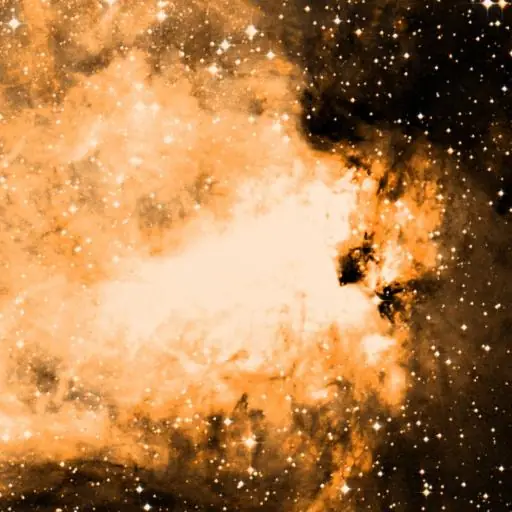
An Orion Nebula seen from the side — one of the brightest, most massive star nurseries in the galaxy.
Turn the Orion Nebula on its side and you have something like M 17. Both are vast stellar nurseries with a similar layout, but we see this one edge-on. It is one of the brightest and most massive star-forming regions in the Milky Way, part of a cloud holding some 30,000 Suns’ worth of gas and dust.
Its glow comes from a cluster of hot young stars — up to 800 of them, nine of the fierce O type — only about a million years old. More than a thousand more are still forming around the edges. In 2020 the airborne SOFIA observatory found nine protostars never seen before, and its images suggest parts of this emission nebula formed separately, helping give it its swan-like outline.
Philippe Loys de Chéseaux discovered it in 1745. When John Herschel sketched it in 1833, he wrote that its figure was “nearly that of a Greek capital omega”.
Omega Nebula (M 17) is 5,200 light-years away: the light we see from it set off around 3180 BC, around the time writing was invented in Mesopotamia.
Did you know?
- A nebula of many names. Different observers have seen different shapes in it, so M 17 is known as the Omega, Swan, Checkmark, Lobster and Horseshoe Nebula.
- Had it changed?. Comparing the nebula with his 1837 drawing, John Herschel suspected part of it had really changed in brightness. Observations by a Yale student, Mr Mason, made two years after that drawing, weakened the case.
How big is it?
3.9 times the distance from the Sun to the nearest star. Light itself takes 17 years to cross it. Shrink our Solar System — the Sun and all eight planets — to the size of a coin, and the Omega Nebula would be 420 m across (4 football pitches end to end); the nearest star would be a football pitch away, and the Milky Way 2,520 km across.
One of the brightest nebulae in the sky: a glowing bar with a hook at one end, which gives it the Swan, Omega and Checkmark names. Striking even in small telescopes, it responds superbly to a UHC or OIII filter.
When and where to see it
It is best placed in the evening sky around July, when it crosses the meridian at about 10 pm local time (around midnight in June). It can be seen from everywhere south of 74°N and never sets south of 74°S.
At its highest it stands 24° up from 50°N, 39° up from 35°N, 74° up from the equator, 71° up from 35°S.
Facts
- Type
- Emission nebula
- Constellation
- Sagittarius
- Designations
- M 17, NGC 6618, Checkmark Nebula, Lobster Nebula, Swan Nebula, Horseshoe Nebula
- Magnitude
- 6.0
- Apparent size
- 11′
- Position
- RA 18h 20.8m, Dec −16° 10′ (J2000)
- Distance
- 5,200 light-years
- Discovered
- Philippe Loys de Chéseaux, 1745
Open AstroPilot to see when Omega Nebula (M 17) is highest tonight from your location, how easy it is with your telescope or binoculars, and an eyepiece view.