Eagle Nebula (M 16)
Eagle Nebula (M 16) is a cluster + nebula in the constellation Serpens, magnitude 6.4, 33′ × 27′ across.
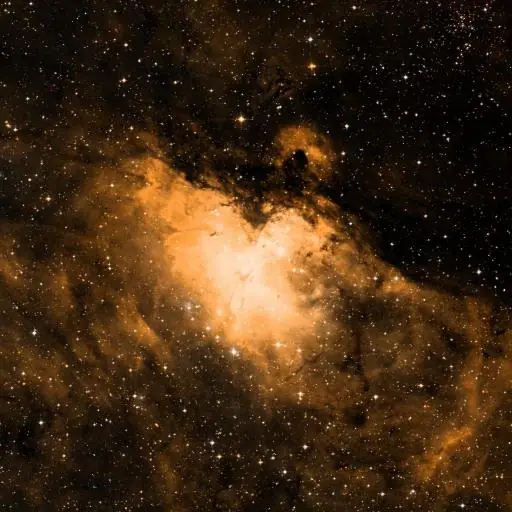
Home of the Pillars of Creation — towers of gas and dust where new stars are still being born.
In 1995 Jeff Hester and Paul Scowen turned the Hubble Space Telescope on the heart of the Eagle Nebula. One of their pictures became famous as the Pillars of Creation: dark columns of hydrogen gas and dust, rising like stalagmites from the floor of a cavern. Inside them are knots of denser gas called EGGs — evaporating gaseous globules — and in some of these, stars are forming.
The light that sculpts the pillars comes from a young star cluster only 1–2 million years old, with some 8,100 stars. Its brightest member is really a pair of hot stars, about 80 times the Sun’s mass in total and up to a million times more luminous.
Jean-Philippe de Chéseaux discovered the cluster in 1745–46. Robert Burnham Jr. saw the central pillar as a queen in silhouette, which gave the nebula its other name: the Star Queen.
Eagle Nebula (M 16) is 5,500 light-years away: the light we see from it set off around 3480 BC, 270 years before writing was invented in Mesopotamia.
Did you know?
- The supernova that wasn’t. In 2007, Spitzer data hinted that a supernova blast was already sweeping through the nebula and would destroy the pillars. Hubble’s second look in 2014 found no evidence of it: the pillars should last, in some form, at least 100,000 more years.
- Twenty years apart. Hubble photographed the pillars again in 2014, in visible and infrared light. Comparing the two sets of images, taken 20 years apart, let astronomers measure how fast the columns are evaporating.
- Not hot enough yet. Chandra X-ray images show young stars dotted across the nebula but not in the pillars: any stars forming inside the EGGs are not yet hot enough to shine in X-rays.
How big is it?
12 times the distance from the Sun to the nearest star. Light itself takes 53 years to cross it. Gaia has picked out 504 stars moving together through space as its members. Shrink our Solar System — the Sun and all eight planets — to the size of a coin, and the Eagle Nebula would be 1.33 km across (a 15-minute walk); the nearest star would be a football pitch away, and the Milky Way 2,520 km across.
A young star cluster inside the Eagle Nebula, home of the 'Pillars of Creation' photographed by Hubble. Small telescopes show the cluster easily; the nebula and its dark pillars need dark skies and a UHC or OIII filter.
When and where to see it
It is best placed in the evening sky around July, when it crosses the meridian at about 10 pm local time (around midnight in June). It can be seen from everywhere south of 76°N and never sets south of 76°S.
At its highest it stands 26° up from 50°N, 41° up from 35°N, 76° up from the equator, 69° up from 35°S.
Facts
- Type
- Cluster + nebula
- Constellation
- Serpens
- Designations
- M 16, NGC 6611, IC 4703, Star Queen
- Magnitude
- 6.4
- Apparent size
- 33′ × 27′
- Position
- RA 18h 18.8m, Dec −13° 48′ (J2000)
- Distance
- 5,500 light-years
- Discovered
- Jean-Philippe de Chéseaux, 1745, Found in 1745–46
Open AstroPilot to see when Eagle Nebula (M 16) is highest tonight from your location, how easy it is with your telescope or binoculars, and an eyepiece view.