M 110 (NGC 205)
M 110 (NGC 205) is a galaxy in the constellation Andromeda, magnitude 8.5, 16′ × 9.6′ across.
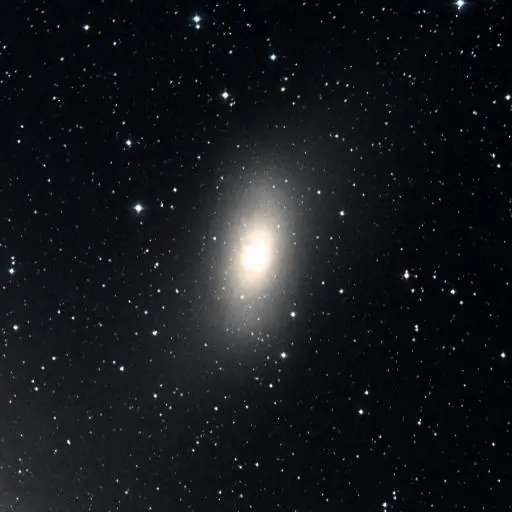
Andromeda’s faint companion, sketched by Messier in 1773 but numbered only in the 20th century.
Look closely at Charles Messier’s drawing of the Andromeda ‘nebula’ and you will find two smaller smudges beside it. One is M 32; the other is this galaxy. A label on the drawing shows he first saw it in 1773, yet he never gave it a number. Caroline Herschel found it independently on 27 August 1783, and her brother William described her discovery in 1785. It became M 110 only in the 20th century, at the suggestion of Kenneth Glyn Jones.
M 110 is a dwarf elliptical galaxy in orbit around the Andromeda Galaxy. Unusually for its kind, it has patches of dust and young blue stars near its centre, and no one is sure why. Much of its gas seems to have been blown out by exploding stars and then stripped away by Andromeda’s tides.
M 110 (NGC 205) is 2.5 million light-years away: the light we see from it set off about 2.5 million years ago, when our distant ancestors were making the first stone tools.
Did you know?
- No giant black hole. Unlike its neighbour M 32, M 110 shows no evidence of a supermassive black hole at its centre.
- Leader of a lost pack?. About half of Andromeda’s satellite galaxies orbit in a single flat plane. One model suggests these 16 once travelled with M 110, until a close pass by Andromeda broke the group apart.
How big is it?
12% of the Milky Way’s width. Light itself takes 12,000 years to cross it. Shrink it to the length of a football pitch and our whole Solar System would be about the size of a red blood cell.
A large elliptical satellite of the Andromeda Galaxy, fainter and more diffuse than M32, northwest of M31's core; it was the last object added to the Messier list, in 1967.
When and where to see it
It is best placed in the evening sky around November, when it crosses the meridian at about 10 pm local time (around midnight in October). It can be seen from everywhere north of 48°S and never sets north of 48°N.
At its highest it stands 82° up from 50°N, 83° up from 35°N, 48° up from the equator, 13° up from 35°S.
Facts
- Type
- Galaxy
- Constellation
- Andromeda
- Designations
- NGC 205
- Magnitude
- 8.5
- Apparent size
- 16′ × 9.6′
- Position
- RA 0h 40.4m, Dec +41° 41′ (J2000)
- Distance
- 2.5 million light-years
- Discovered
- Charles Messier, 1773, Drawn by Messier but not numbered; found independently by Caroline Herschel in 1783
Open AstroPilot to see when M 110 (NGC 205) is highest tonight from your location, how easy it is with your telescope or binoculars, and an eyepiece view.