M 109 (NGC 3992)
M 109 (NGC 3992) is a galaxy in the constellation Ursa Major, magnitude 9.8, 8.1′ × 5.6′ across.
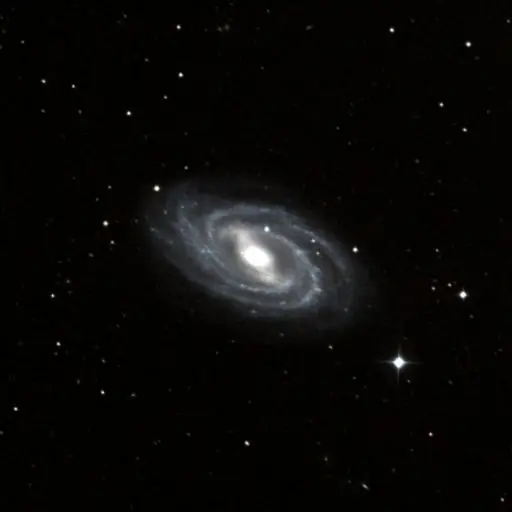
The most distant object in Messier’s catalogue, and the leading light of a family of perhaps fifty galaxies.
Of the 110 objects in Messier’s catalogue, M 109 is the most distant. This barred spiral galaxy, nicknamed the Vacuum Cleaner Galaxy, is the brightest member of the M 109 Group, a gathering in Ursa Major that may hold more than 50 galaxies. At least three small satellite galaxies orbit it.
Radio maps of its hydrogen reveal a hole at the centre, where the bar lies. The bar may have funnelled the gas inwards, and the emptiness of the hole suggests that no large amount of gas has fallen in recently.
Pierre Méchain discovered M 109 in 1781, and Messier later appended it to his catalogue.
M 109 (NGC 3992) is 78 million light-years away: the light we see from it set off about 78 million years ago, when dinosaurs still walked the Earth.
Did you know?
- One lone supernova. In March 1956 Howard S. Gates spotted supernova SN 1956A in M 109, using the 18-inch Schmidt telescope at Palomar Observatory. It is the only supernova seen there so far.
- Where does the list end?. For decades astronomers disagreed over entries past M 103. Sir Patrick Moore stopped at M 104 and listed M 105 to M 109 as extras; by the late 1970s all 110 were in common use.
How big is it?
1.8 times as wide as our Milky Way. Light itself takes 180,000 years to cross it. Shrink it to the length of a football pitch and our whole Solar System would be smaller than a bacterium.
A barred spiral in Ursa Major just southeast of Phecda (Gamma Ursae Majoris); its bar shows as an elongated core in medium telescopes.
When and where to see it
It is best placed in the evening sky around April, when it crosses the meridian at about 10 pm local time (around midnight in March). It can be seen from everywhere north of 37°S and never sets north of 37°N.
At its highest it stands 87° up from 50°N, 72° up from 35°N, 37° up from the equator, 2° up from 35°S.
Facts
- Type
- Galaxy
- Constellation
- Ursa Major
- Designations
- NGC 3992, Vacuum Cleaner Galaxy
- Magnitude
- 9.8
- Apparent size
- 8.1′ × 5.6′
- Position
- RA 11h 57.6m, Dec +53° 23′ (J2000)
- Distance
- 78 million light-years
- Discovered
- Pierre Méchain, 1781
Open AstroPilot to see when M 109 (NGC 3992) is highest tonight from your location, how easy it is with your telescope or binoculars, and an eyepiece view.