M 108 (NGC 3556)
M 108 (NGC 3556) is a galaxy in the constellation Ursa Major, magnitude 10.0, 8.7′ × 2.2′ across.
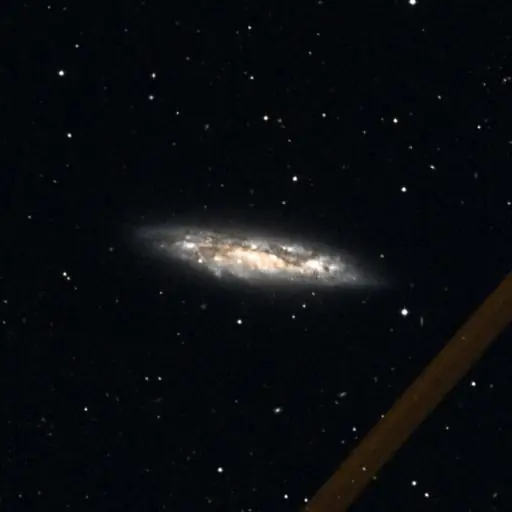
The Surfboard Galaxy, where Spitzer caught a supernova so smothered in dust that only infrared could see it.
Nicknamed the Surfboard, M 108 is a barred spiral galaxy tipped almost edge-on to us — and something of a loner, an isolated member of the Ursa Major Cloud of galaxies. It weighs around 125 billion suns, and about 290 globular clusters swarm around it.
Its hydrogen gas holds a puzzle: huge expanding shells, perhaps blown out by generations of exploding stars, perhaps by gas falling in from intergalactic space or by jets from its core. Chandra has found 83 X-ray sources in it. The brightest may be an intermediate-mass black hole — heavier than those left by single stars, far lighter than the giants in galaxy cores. Pierre Méchain discovered M 108 in 1781 or 1782.
M 108 (NGC 3556) is 31 million light-years away: the light we see from it set off about 31 million years ago, when the Himalayas and the Alps were rising.
Did you know?
- A supernova in disguise. In 2016 the Spitzer Space Telescope caught SPIRITS 16tn, a supernova so buried in dust that it could be seen only in infrared light — one of the most heavily obscured ever observed.
- A stripped star’s end. SN 2023dbc, found in M 108 in March 2023, is among the nearest Type Ic supernovae yet discovered — the explosion of a star that had lost its outer hydrogen.
How big is it?
78% of the Milky Way’s width. Light itself takes 78,000 years to cross it. Shrink it to the length of a football pitch and our whole Solar System would be smaller than a bacterium.
An edge-on barred spiral in Ursa Major, a mottled sliver of light 48′ from the Owl Nebula (M97); the two make a fine pair.
When and where to see it
It is best placed in the evening sky around April, when it crosses the meridian at about 10 pm local time (around midnight in March). It can be seen from everywhere north of 34°S and never sets north of 34°N.
At its highest it stands 84° up from 50°N, 69° up from 35°N, 34° up from the equator, below the horizon from 35°S.
Facts
- Type
- Galaxy
- Constellation
- Ursa Major
- Designations
- NGC 3556, Surfboard Galaxy
- Magnitude
- 10.0
- Apparent size
- 8.7′ × 2.2′
- Position
- RA 11h 11.5m, Dec +55° 40′ (J2000)
- Distance
- 31 million light-years
- Discovered
- Pierre Méchain, Found in 1781 or 1782
Open AstroPilot to see when M 108 (NGC 3556) is highest tonight from your location, how easy it is with your telescope or binoculars, and an eyepiece view.