M 106 (NGC 4258)
M 106 (NGC 4258) is a galaxy in the constellation Canes Venatici, magnitude 8.4, 17′ × 7.2′ across.
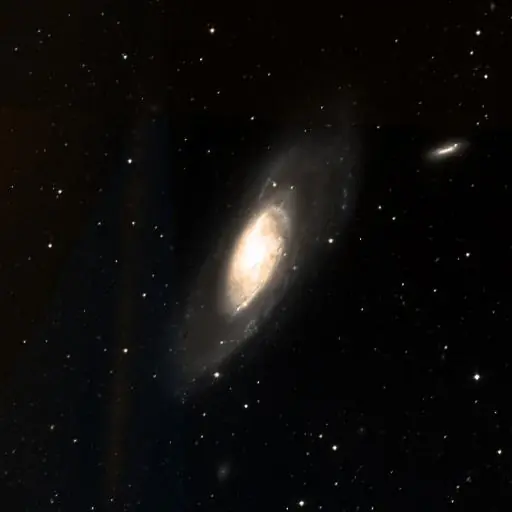
Where water molecules around a black hole gave astronomers their first direct measure of a galaxy’s distance.
Close to the core of M 106, a thin, slightly warped disc of gas whirls around a black hole of about 39 million suns. Water molecules in the disc act like a natural microwave laser, a ‘megamaser’, sending out sharp radio signals. By tracking that spinning disc, radio astronomers proved the black hole was there — and measured the galaxy’s distance directly, a first for any galaxy.
Pierre Méchain discovered M 106 in 1781. This spiral galaxy is one of the largest and brightest galaxies in our part of the universe, similar in size and luminosity to the Andromeda Galaxy, and its core is an active Seyfert nucleus, lit up by gas falling towards the black hole.
M 106 (NGC 4258) is 24 million light-years away: the light we see from it set off about 24 million years ago, when the Himalayas and the Alps were rising.
Did you know?
- Calibrating the cosmos. M 106 holds Cepheid variable stars with a range of chemical make-ups, some like the Milky Way’s and some like other galaxies’. That lets astronomers cross-check these ‘standard candles’ and sharpen distances across the universe.
- Found in the archives. Two supernovae have been seen in M 106, in 1981 and 2014. The first, SN 1981K, was reported by E. Hummel and confirmed by Paul Wild from archive photographs.
How big is it?
1.2 times as wide as our Milky Way. Light itself takes 120,000 years to cross it. Shrink it to the length of a football pitch and our whole Solar System would be smaller than a bacterium.
A large, bright spiral in Canes Venatici with an active nucleus; telescopes show an elongated glow with a bright core, and photographs reveal extra 'anomalous' arms.
When and where to see it
It is best placed in the evening sky around April, when it crosses the meridian at about 10 pm local time (around midnight in March). It can be seen from everywhere north of 43°S and never sets north of 43°N.
At its highest it stands 87° up from 50°N, 78° up from 35°N, 43° up from the equator, 8° up from 35°S.
Facts
- Type
- Galaxy
- Constellation
- Canes Venatici
- Designations
- NGC 4258
- Magnitude
- 8.4
- Apparent size
- 17′ × 7.2′
- Position
- RA 12h 19.0m, Dec +47° 18′ (J2000)
- Distance
- 24 million light-years
- Discovered
- Pierre Méchain, 1781
Open AstroPilot to see when M 106 (NGC 4258) is highest tonight from your location, how easy it is with your telescope or binoculars, and an eyepiece view.