M 105 (NGC 3379)
M 105 (NGC 3379) is a galaxy in the constellation Leo, magnitude 9.3, 4.9′ × 4.3′ across.
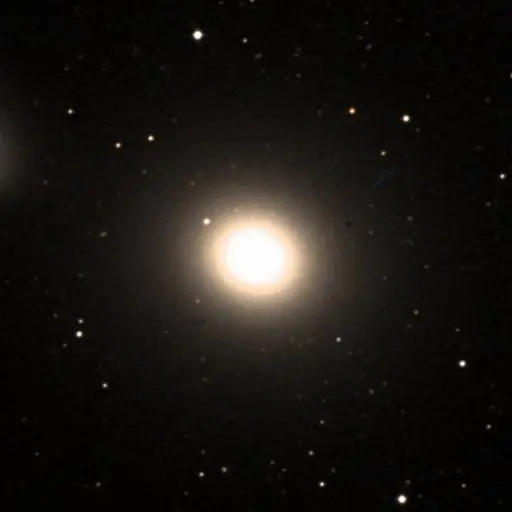
A calm, smooth elliptical galaxy that joined Messier’s list only after a forgotten letter came to light.
Some galaxies are all drama; M 105 is the picture of calm. It is a near-perfect oval of old stars, with no spiral arms and barely a ripple in its smooth glow — a textbook elliptical galaxy, and the biggest one in the Messier catalogue outside the Virgo Cluster. At its heart sits a black hole of between 140 and 200 million suns.
Pierre Méchain found it in 1781, a few days after M 95 and M 96. Messier never checked it himself, so it was left out of his catalogue. It was added only in 1947, after Helen Sawyer Hogg came across a letter in which Méchain described where it lay.
M 105 (NGC 3379) is 36 million light-years away: the light we see from it set off about 36 million years ago, when the Himalayas and the Alps were rising.
Did you know?
- A giant ring of gas. M 105 and its neighbour NGC 3384 lie inside an enormous ring of hydrogen holding nearly two billion suns’ worth of gas — and new stars are forming in it.
- Not quite retired. Ellipticals are known for old stars, but M 105 hosts a few young stars and star clusters. Even such quiet galaxies, it seems, can still make stars — just very slowly.
- A group with several leaders. M 105 belongs to the M 96 Group, one of the richest galaxy groups in our cosmic neighbourhood. Rather than one giant, several large galaxies share the lead.
How big is it?
51% of the Milky Way’s width. Light itself takes 51,000 years to cross it. Shrink it to the length of a football pitch and our whole Solar System would be smaller than a bacterium.
An elliptical galaxy in the Leo I Group, a round glow with a bright core near M95 and M96.
When and where to see it
It is best placed in the evening sky around April, when it crosses the meridian at about 10 pm local time (around midnight in March). It can be seen from everywhere north of 77°S and never sets north of 77°N.
At its highest it stands 53° up from 50°N, 68° up from 35°N, 77° up from the equator, 42° up from 35°S.
Facts
- Type
- Galaxy
- Constellation
- Leo
- Designations
- NGC 3379
- Magnitude
- 9.3
- Apparent size
- 4.9′ × 4.3′
- Position
- RA 10h 47.8m, Dec +12° 35′ (J2000)
- Distance
- 36 million light-years
- Discovered
- Pierre Méchain, 1781
Open AstroPilot to see when M 105 (NGC 3379) is highest tonight from your location, how easy it is with your telescope or binoculars, and an eyepiece view.