Sombrero Galaxy (M 104)
Sombrero Galaxy (M 104) is a galaxy in the constellation Virgo, magnitude 8.0, 8.4′ × 4.9′ across.
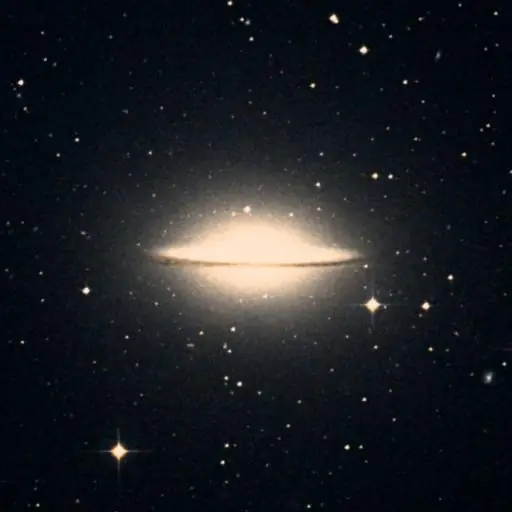
A galaxy dressed as a hat, with a black hole of hundreds of millions of suns at its heart.
Tip a galaxy almost edge-on, give it a swollen glowing centre and a dark band of dust, and you get the Sombrero. That dark band is really a ring of dust and cold gas circling the bulge, and it is where this galaxy makes most of its new stars. The whole galaxy weighs about 800 billion suns. Its classification is unclear: the Spitzer Space Telescope found its halo far larger and more massive than expected — more like that of a giant elliptical galaxy than a spiral.
Pierre Méchain found it on 11 May 1781, and William Herschel independently in 1784, noting a “dark stratum” — the dust lane. Messier jotted it into his personal list, but only in 1921, when Camille Flammarion came across that handwritten note, did it officially become M 104.
Sombrero Galaxy (M 104) is 32 million light-years away: the light we see from it set off about 32 million years ago, when the Himalayas and the Alps were rising.
Did you know?
- A heavyweight black hole. In the 1990s John Kormendy’s team found stars near the centre moving so fast that about a billion suns’ worth of mass must lie hidden there. A 2016 study revised it to about 640 million.
- A swarm of globulars. The Sombrero has an estimated 1,200 to 2,000 globular clusters — around ten times as many as the Milky Way. Galaxies with big bulges tend to have more of them.
- An unexplained signal. In 2006 astronomers measured terahertz radiation from the Sombrero’s core that matches none of the usual sources — not warm dust, not hot gas, not fast electrons. Its origin is still unknown.
How big is it?
79% of the Milky Way’s width. Light itself takes 79,000 years to cross it. Shrink it to the length of a football pitch and our whole Solar System would be smaller than a bacterium.
A nearly edge-on spiral with a huge central bulge and a dark dust lane — visible in medium telescopes — that give it the look of a broad-brimmed hat.
When and where to see it
It is best placed in the evening sky around May, when it crosses the meridian at about 10 pm local time (around midnight in April). It can be seen from everywhere south of 78°N and never sets south of 78°S.
At its highest it stands 28° up from 50°N, 43° up from 35°N, 78° up from the equator, 67° up from 35°S.
Facts
- Type
- Galaxy
- Constellation
- Virgo
- Designations
- M 104, NGC 4594
- Magnitude
- 8.0
- Apparent size
- 8.4′ × 4.9′
- Position
- RA 12h 40.0m, Dec −11° 37′ (J2000)
- Distance
- 32 million light-years
- Discovered
- Pierre Méchain, 1781, Found independently by William Herschel in 1784; added to the Messier list in 1921
Open AstroPilot to see when Sombrero Galaxy (M 104) is highest tonight from your location, how easy it is with your telescope or binoculars, and an eyepiece view.