M 103 (NGC 581)
M 103 (NGC 581) is an open cluster in the constellation Cassiopeia, magnitude 7.4, 6.0′ across.
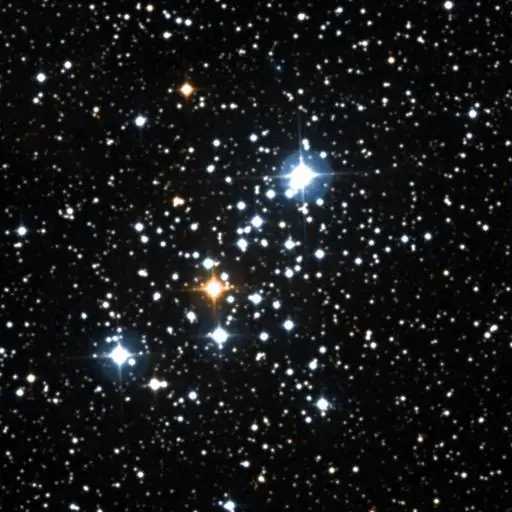
The last object Messier published himself: a young family of stars, born long after the dinosaurs died.
On 27 March 1781 Pierre Méchain found a small knot of stars in Cassiopeia, and Charles Messier added it to his catalogue. M 103 was the last entry in the list as Messier published it in 1781; the seven after it were added by later astronomers, working from his notes and Méchain’s letters.
Its stars are young, somewhere between about 13 and 25 million years old. Around 172 are thought to belong to this open cluster, and near its centre glows a red giant. A bright double star in the same view, Struve 131, is not a member at all — it simply lies in the foreground.
M 103 (NGC 581) is 8,200 light-years away: the light we see from it set off around 6180 BC, 670 years before the first towns were growing in the Fertile Crescent.
Did you know?
- Counting the family. Åke Wallenquist first counted 40 member stars in M 103. Antonín Bečvář raised that to 60, and modern estimates put it at about 172.
- On Cassiopeia’s knee. Admiral William Smyth noted the cluster’s red giant as a double star on Cassiopeia’s knee — a spot on the figure of the seated queen in the old star maps.
How big is it?
Born about 28 million years ago, when the Himalayas and the Alps were rising. Light itself takes 14 years to cross it. Gaia has picked out 211 stars moving together through space as its members. That’s 3.4 times the distance from the Sun to the nearest star. Shrink our Solar System — the Sun and all eight planets — to the size of a coin, and M 103 would be 361 m across (3 football pitches end to end); the nearest star would be a football pitch away, and the Milky Way 2,520 km across.
A small, bright open cluster in Cassiopeia shaped like a fan or arrowhead, about 1° from Delta Cassiopeiae (Ruchbah).
When and where to see it
It is best placed in the evening sky around November, when it crosses the meridian at about 10 pm local time (around midnight in October). It can be seen from everywhere north of 29°S and never sets north of 29°N.
At its highest it stands 79° up from 50°N, 64° up from 35°N, 29° up from the equator, below the horizon from 35°S.
Facts
- Type
- Open cluster
- Constellation
- Cassiopeia
- Designations
- NGC 581, Mel 8, Cr 14, Melotte 8, Collinder 14
- Magnitude
- 7.4
- Apparent size
- 6.0′
- Position
- RA 1h 33.4m, Dec +60° 39′ (J2000)
- Distance
- 8,200 light-years
- Discovered
- Pierre Méchain, 1781
Open AstroPilot to see when M 103 (NGC 581) is highest tonight from your location, how easy it is with your telescope or binoculars, and an eyepiece view.