M 102 (NGC 5866)
M 102 (NGC 5866) is a galaxy in the constellation Draco, magnitude 9.9, 6.3′ × 2.7′ across.
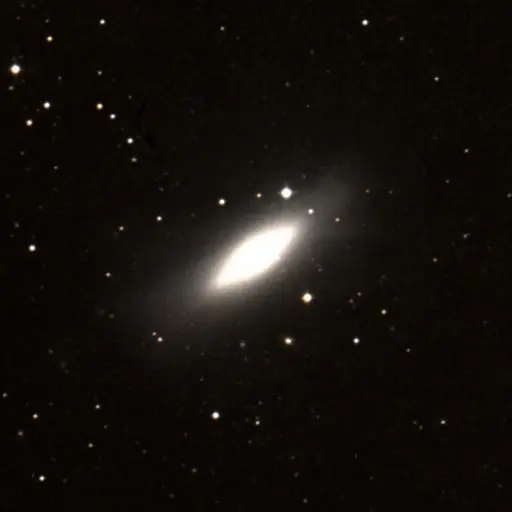
The Messier entry nobody can pin down — its own discoverer said it was a mistake.
Every catalogue has its mysteries, and M 102 is the great puzzle of Messier’s list. In spring 1781 Pierre Méchain reported a very faint nebula between the stars Omicron Boötis and Iota Draconis, and Messier added it — but without giving its position.
Two years later Méchain took it back. In a letter to the astronomer J. Bernoulli he wrote that numbers 101 and 102 were the same nebula, counted twice because of an error in the star charts. That might have settled it, but Messier’s own handwritten notes give a position that matches NGC 5866, a lens-shaped galaxy in Draco that also fits Méchain’s description.
NGC 5866, nicknamed the Spindle, is now the favourite, and NASA treats it as M 102. But the case has never been fully closed.
M 102 (NGC 5866) is 50 million light-years away: the light we see from it set off about 50 million years ago, when mammals were taking over a world without dinosaurs.
Did you know?
- The other suspects. Galaxies near NGC 5866 — NGC 5879, NGC 5907 and NGC 5908 — have been proposed too. None is as bright, or as high in surface brightness, so they are less likely.
- A typo theory. J. L. E. Dreyer, compiler of the New General Catalogue, wondered whether Iota Serpentis had been mixed up with Iota Draconis. That would point to NGC 5928 — but it is far too faint for Messier’s telescopes.
How big is it?
About as wide as our Milky Way. Light itself takes 92,000 years to cross it. Shrink it to the length of a football pitch and our whole Solar System would be smaller than a bacterium.
Most likely the lenticular galaxy NGC 5866 (the Spindle), seen nearly edge-on with a dark dust lane along its length. Its identity is disputed: Méchain later called it a duplicate observation of M101.
When and where to see it
It is best placed in the evening sky around June, when it crosses the meridian at about 10 pm local time (around midnight in May). It can be seen from everywhere north of 34°S and never sets north of 34°N.
At its highest it stands 84° up from 50°N, 69° up from 35°N, 34° up from the equator, below the horizon from 35°S.
Facts
- Type
- Galaxy
- Constellation
- Draco
- Designations
- NGC 5866, Spindle Galaxy
- Magnitude
- 9.9
- Apparent size
- 6.3′ × 2.7′
- Position
- RA 15h 6.5m, Dec +55° 46′ (J2000)
- Distance
- 50 million light-years
- Discovered
- Pierre Méchain, 1781, Identity disputed; usually taken to be NGC 5866
Open AstroPilot to see when M 102 (NGC 5866) is highest tonight from your location, how easy it is with your telescope or binoculars, and an eyepiece view.