Pinwheel Galaxy (M 101)
Pinwheel Galaxy (M 101) is a galaxy in the constellation Ursa Major, magnitude 7.9, 24′ × 23′ across.
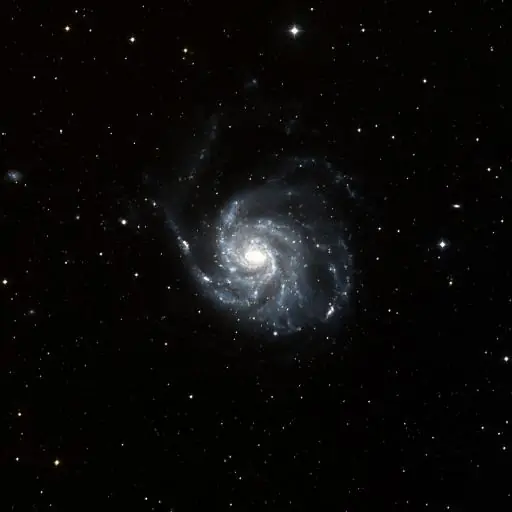
A giant spiral of around a trillion stars, where bright supernovae flared in 2011 and 2023.
Count the stars in M 101 and you would reach around a trillion. Its arms are studded with glowing clouds of gas lit by hot young stars — a 1990 study catalogued 1,264 of them, and three are bright enough to carry NGC numbers of their own. The pull of its companion galaxies has made M 101 lopsided, squeezing its gas and setting off bursts of star birth along the arms.
Pierre Méchain found it in 1781, describing a nebula “very obscure and pretty large”. William Herschel suspected its mottled glow might one day be resolved into stars, and in the 19th century Lord Rosse sketched its spiral with his 72-inch reflector. In 2006 Hubble combined 51 exposures into what was then its largest and most detailed image of any galaxy.
Pinwheel Galaxy (M 101) is 22 million light-years away: the light we see from it set off about 22 million years ago, when the Himalayas and the Alps were rising.
Did you know?
- Supernova season. Six supernovae have been seen in M 101. SN 2011fe reached magnitude 9.9, the brightest of 2011, and in May 2023 Kōichi Itagaki discovered SN 2023ixf.
- A greedy black hole. The X-ray source M101 ULX-1 is a black hole of just 20 to 30 suns paired with a companion star. It swallows matter faster than theory says it should.
- As many globulars as ours. M 101 has about 150 globular clusters — the same number as our own Milky Way.
How big is it?
1.5 times as wide as our Milky Way. Light itself takes 150,000 years to cross it. Shrink it to the length of a football pitch and our whole Solar System would be smaller than a bacterium. It holds about 130 billion stars — the Milky Way has a few hundred billion.
A large face-on spiral with low surface brightness: from dark sites binoculars show a faint round glow, and telescopes reveal knotty arms dotted with bright star-forming regions.
When and where to see it
It is best placed in the evening sky around May, when it crosses the meridian at about 10 pm local time (around midnight in April). It can be seen from everywhere north of 36°S and never sets north of 36°N.
At its highest it stands 86° up from 50°N, 71° up from 35°N, 36° up from the equator, 1° up from 35°S.
Facts
- Type
- Galaxy
- Constellation
- Ursa Major
- Designations
- M 101, NGC 5457
- Magnitude
- 7.9
- Apparent size
- 24′ × 23′
- Position
- RA 14h 3.2m, Dec +54° 21′ (J2000)
- Distance
- 22 million light-years
- Discovered
- Pierre Méchain, 1781
Open AstroPilot to see when Pinwheel Galaxy (M 101) is highest tonight from your location, how easy it is with your telescope or binoculars, and an eyepiece view.