M 100 (NGC 4321)
M 100 (NGC 4321) is a galaxy in the constellation Coma Berenices, magnitude 9.3, 6.1′ × 5.6′ across.
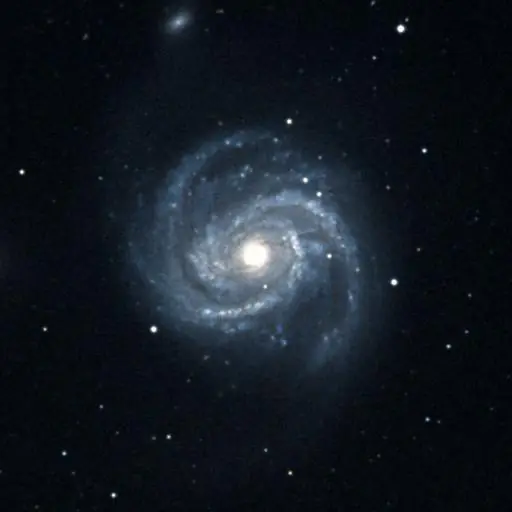
A grand spiral of the Virgo Cluster, where seven exploding stars have been seen since 1901.
Deep in the heart of M 100, two tightly wound spiral arms coil around a small central bar, forming a ring of furious star birth. Stars have been forming there in separate bursts for at least 500 million years, and astronomers class M 100 as a starburst galaxy.
Pierre Méchain found it in 1781, and Charles Messier saw it 29 days later, noting a faint nebula without a star. Admiral William Smyth later called it a pearly white nebula. In 1850 Lord Rosse listed it among just fourteen known ‘spiral nebulae’ — at a time when nobody knew these were galaxies in their own right.
M 100 (NGC 4321) is 47 million light-years away: the light we see from it set off about 47 million years ago, when mammals were taking over a world without dinosaurs.
Did you know?
- Seven supernovae. Seven supernovae have been found in M 100 since 1901. The first two were spotted by Heber Curtis, who in 1920 argued that spiral nebulae are separate galaxies — and was proved right.
- An amateur’s catch. On 15 April 1979 amateur astronomer Gus Johnson discovered SN 1979C in M 100. Its remnant has since been traced at wavelengths from X-rays to radio waves.
- Little companions. Two small satellite galaxies, NGC 4323 and NGC 4328, accompany M 100. NGC 4323 is linked to it by a bridge of glowing matter.
How big is it?
83% of the Milky Way’s width. Light itself takes 83,000 years to cross it. Shrink it to the length of a football pitch and our whole Solar System would be smaller than a bacterium. It holds about 400 billion stars — the Milky Way has a few hundred billion.
A large, face-on grand-design spiral in the Virgo Cluster; telescopes show a round glow with a bright core, and large apertures its two main arms.
When and where to see it
It is best placed in the evening sky around April, when it crosses the meridian at about 10 pm local time (around midnight in March). It can be seen from everywhere north of 74°S and never sets north of 74°N.
At its highest it stands 56° up from 50°N, 71° up from 35°N, 74° up from the equator, 39° up from 35°S.
Facts
- Type
- Galaxy
- Constellation
- Coma Berenices
- Designations
- NGC 4321, Mirror Galaxy
- Magnitude
- 9.3
- Apparent size
- 6.1′ × 5.6′
- Position
- RA 12h 22.9m, Dec +15° 49′ (J2000)
- Distance
- 47 million light-years
- Discovered
- Pierre Méchain, 1781
Open AstroPilot to see when M 100 (NGC 4321) is highest tonight from your location, how easy it is with your telescope or binoculars, and an eyepiece view.