Crab Nebula (M 1)
Crab Nebula (M 1) is a supernova remnant in the constellation Taurus, magnitude 8.4, 6.0′ × 4.0′ across.
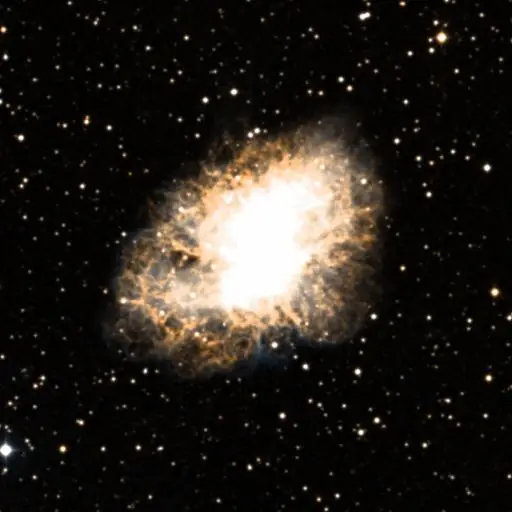
The wreckage of a star that blazed in daylight in 1054 — and the object that started Messier’s list.
On 4 July 1054, Chinese astronomers recorded a “guest star” in Taurus, bright enough to see in daylight. At its peak it outshone everything in the night sky except the Moon, and it stayed visible to the naked eye for about two years. The Crab Nebula is what that explosion left behind: a supernova remnant still flying apart at about 1,500 kilometres per second, with a neutron star no wider than a city at its heart.
John Bevis found the glowing cloud in 1731. In 1758 Charles Messier, searching for the predicted return of Halley’s Comet, came across it and at first thought he had found the comet. When it refused to move, he realised such fixed smudges would keep fooling comet hunters, so he began listing them. The Crab became number one in the Messier catalogue.
Its name comes from Lord Rosse, whose drawing in the early 1840s gave it crab-like arms. Looking again in 1848 with a bigger telescope, he could no longer see the likeness — but the name stuck.
Crab Nebula (M 1) is 6,500 light-years away: the light we see from it set off around 4480 BC, 1,030 years after the first towns were growing in the Fertile Crescent.
Did you know?
- The first supernova match. The Crab was the first object in the sky linked to a supernova recorded in history. The case was built in the 1920s, once photographs showed the cloud was expanding.
- Proof that pulsars spin. When the Crab’s pulsar was pinned down in 1968, it settled a debate: pulsars are rapidly rotating neutron stars, not pulsating white dwarfs as many had suggested.
- A dead star with a birthday. Because the explosion was dated almost to the day, the Crab Pulsar is the only pulsar from a historical supernova whose age is known for certain — a yardstick for the physics of dead stars.
- A lamp behind the Solar System. Its radio waves passing through the Sun’s corona were used to map it in the 1950s and 60s. In 2003, Titan’s atmosphere was measured as Saturn’s moon blocked the Crab’s X-rays.
How big is it?
2.7 times the distance from the Sun to the nearest star. Light itself takes 11 years to cross it. Shrink our Solar System — the Sun and all eight planets — to the size of a coin, and the Crab Nebula would be 286 m across (3 football pitches end to end); the nearest star would be a football pitch away, and the Milky Way 2,520 km across.
The remains of the supernova seen from Earth in 1054, with a pulsar spinning 30 times a second at its heart. Small telescopes show a faint oval glow; larger ones under dark skies hint at its ragged, filamentary edges.
When and where to see it
It is best placed in the evening sky around January, when it crosses the meridian at about 10 pm local time (around midnight in December). It can be seen from everywhere north of 68°S and never sets north of 68°N.
At its highest it stands 62° up from 50°N, 77° up from 35°N, 68° up from the equator, 33° up from 35°S.
Facts
- Type
- Supernova remnant
- Constellation
- Taurus
- Designations
- M 1, NGC 1952
- Magnitude
- 8.4
- Apparent size
- 6.0′ × 4.0′
- Position
- RA 5h 34.5m, Dec +22° 1′ (J2000)
- Distance
- 6,500 light-years
- Discovered
- John Bevis, 1731, Its supernova was seen in 1054
Open AstroPilot to see when Crab Nebula (M 1) is highest tonight from your location, how easy it is with your telescope or binoculars, and an eyepiece view.