IC 5267
IC 5267 is a galaxy in the constellation Grus, magnitude 10.4, 5.6′ × 4.1′ across.
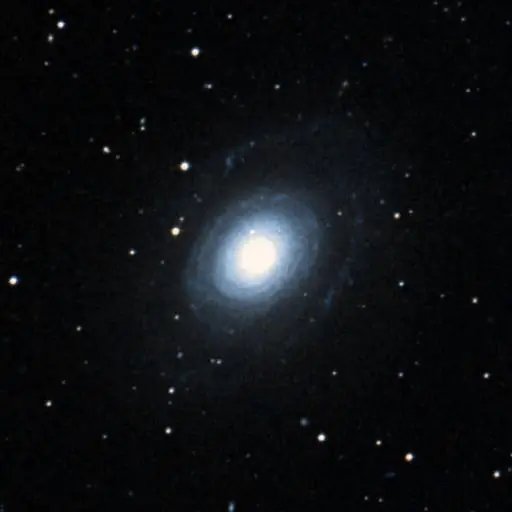
A smooth, lens-shaped galaxy in Grus, caught between the spirals and the ellipticals.
Not every galaxy with a disc has spiral arms. IC 5267 is classed S0-a, on the border between lenticular galaxies and spirals: a lens-shaped system with a bright central bulge and a broad disc, but only faint hints of the spiral structure and fresh star formation that light up galaxies like the Milky Way. Astronomers see lenticulars as a halfway stage between spirals and ellipticals. IC 5267 lies in Grus, the Crane, a little over two degrees from the spiral NGC 7424.
IC 5267 is 68 million light-years away: the light we see from it set off about 68 million years ago, when dinosaurs still walked the Earth.
How big is it?
About as wide as our Milky Way. Light itself takes 110,000 years to cross it. Shrink it to the length of a football pitch and our whole Solar System would be smaller than a bacterium.
A 10.4-magnitude lenticular galaxy (S0-a) in Grus, about 5.6′ × 4.1′.
When and where to see it
It is best placed in the evening sky around October, when it crosses the meridian at about 10 pm local time (around midnight in September). It can be seen from everywhere south of 47°N and never sets south of 47°S.
At its highest it stands below the horizon from 50°N, 12° up from 35°N, 47° up from the equator, 82° up from 35°S.
Facts
- Type
- Galaxy
- Constellation
- Grus
- Designations
- IC 5267
- Magnitude
- 10.4
- Apparent size
- 5.6′ × 4.1′
- Position
- RA 22h 57.2m, Dec −43° 24′ (J2000)
- Distance
- 68 million light-years
Open AstroPilot to see when IC 5267 is highest tonight from your location, how easy it is with your telescope or binoculars, and an eyepiece view.