Cocoon Nebula (IC 5146)
Cocoon Nebula (IC 5146) is a cluster + nebula in the constellation Cygnus, magnitude 7.2, 12′ across.
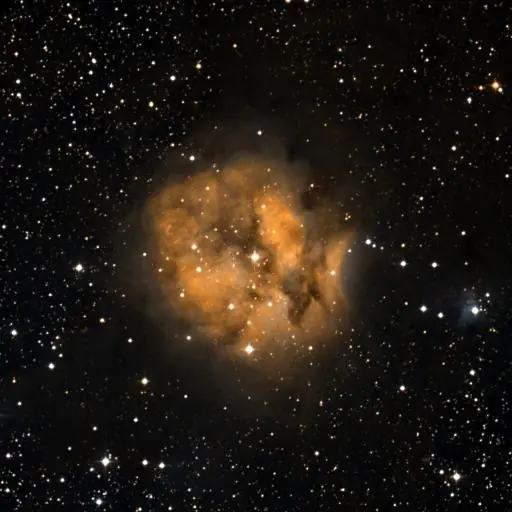
A star younger than humankind, glowing at the head of a long, dark trail of dust.
The star that lights the Cocoon Nebula formed only about 100,000 years ago. When it was born, modern humans were already walking the Earth.
It is not alone. This cluster and nebula is a stellar nursery, and the Spitzer and Chandra space telescopes have together found hundreds of young stars here — some in the glowing gas, others still hidden in the cold, dark cloud that trails away from it like a tail.
Among the heavyweights is BD +46 3474, a hot B-type star of around 14 times the Sun’s mass. Another resident, BD +46 3471, is a Herbig Ae/Be star: a young star of middling mass, still showing strong emission lines from the gas around it.
Cocoon Nebula (IC 5146) is 2,400 light-years away: the light we see from it set off around 380 BC, around the time the Parthenon was dedicated in Athens.
Did you know?
- Light and shadow. The Cocoon is part emission nebula, glowing where its hottest stars ionise the gas, and part reflection nebula, where dust simply scatters their light.
- A cluster in a cocoon. The young stars inside form a cluster of their own, catalogued as Collinder 470 — a family still emerging from the cloud that made it.
How big is it?
Twice the distance from the Sun to the nearest star. Light itself takes 8.4 years to cross it. Gaia has picked out 146 stars moving together through space as its members. Shrink our Solar System — the Sun and all eight planets — to the size of a coin, and the Cocoon Nebula would be 211 m across (2 football pitches end to end); the nearest star would be a football pitch away, and the Milky Way 2,520 km across.
A faint glow around a 10th-magnitude star at the end of the long dark nebula Barnard 168; dark skies and an H-beta or UHC filter help.
When and where to see it
It is best placed in the evening sky around September, when it crosses the meridian at about 10 pm local time (around midnight in August). It can be seen from everywhere north of 43°S and never sets north of 43°N.
At its highest it stands 87° up from 50°N, 78° up from 35°N, 43° up from the equator, 8° up from 35°S.
Facts
- Type
- Cluster + nebula
- Constellation
- Cygnus
- Designations
- IC 5146, C 19
- Magnitude
- 7.2
- Apparent size
- 12′
- Position
- RA 21h 53.5m, Dec +47° 16′ (J2000)
- Distance
- 2,400 light-years
- Discovered
- Edward Emerson Barnard, 1893
Open AstroPilot to see when Cocoon Nebula (IC 5146) is highest tonight from your location, how easy it is with your telescope or binoculars, and an eyepiece view.