Pelican Nebula (IC 5070)
Pelican Nebula (IC 5070) is an emission nebula in the constellation Cygnus, magnitude 8.0 (blue), 1.0° × 50′ across.
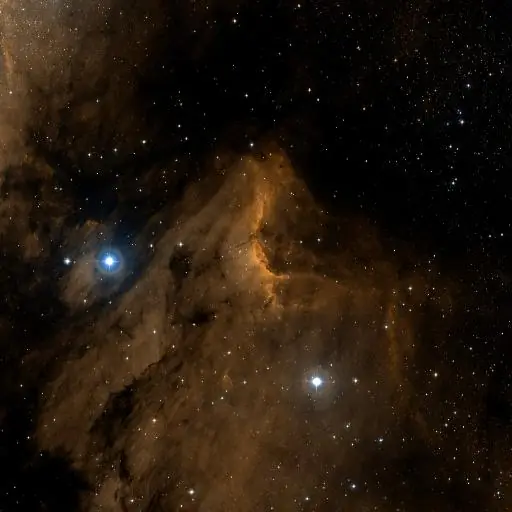
The Pelican Nebula: a glowing cloud beside the North America Nebula, slowly being remade by its own stars.
The Pelican’s likeness is only temporary. This emission nebula is part of the same great cloud of hydrogen as the North America Nebula, separated from it by a band of dark, dusty gas in the foreground. Young, energetic stars are heating the cold gas and pushing a glowing ionisation front steadily outwards. Millions of years from now, the stars and gas will be so rearranged that the Pelican will look like something else entirely.
Pelican Nebula (IC 5070) is 2,600 light-years away: the light we see from it set off around 580 BC, 135 years before the Parthenon was dedicated in Athens.
Did you know?
- Jets in the dark. Among the dense filaments of cold gas that remain is Herbig–Haro object HH 555, which shoots out two jets — the outflows of a young star still forming inside.
How big is it?
11 times the distance from the Sun to the nearest star. Light itself takes 45 years to cross it. Shrink our Solar System — the Sun and all eight planets — to the size of a coin, and the Pelican Nebula would be 1.15 km across (a 15-minute walk); the nearest star would be a football pitch away, and the Milky Way 2,520 km across.
An 8.0-magnitude (B-band) emission nebula in Cygnus, about 60′ × 50′.
When and where to see it
It is best placed in the evening sky around September, when it crosses the meridian at about 10 pm local time (around midnight in August). It can be seen from everywhere north of 46°S and never sets north of 46°N.
At its highest it stands 84° up from 50°N, 81° up from 35°N, 46° up from the equator, 11° up from 35°S.
Facts
- Type
- Emission nebula
- Constellation
- Cygnus
- Designations
- IC 5070
- Magnitude
- 8.0 (blue)
- Apparent size
- 1.0° × 50′
- Position
- RA 20h 51.0m, Dec +44° 24′ (J2000)
- Distance
- 2,600 light-years
- Discovered
- Max Wolf
Open AstroPilot to see when Pelican Nebula (IC 5070) is highest tonight from your location, how easy it is with your telescope or binoculars, and an eyepiece view.