IC 4997
IC 4997 is a planetary nebula in the constellation Sagitta, magnitude 10.5, 2″ across.
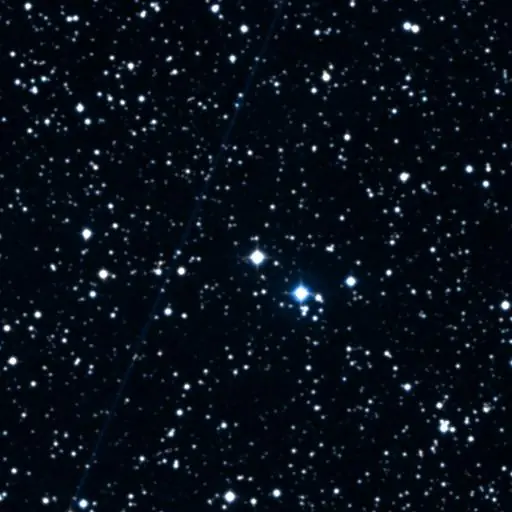
A planetary nebula disguised as a star, whose light changed suddenly in the 1960s.
IC 4997 passes for an ordinary star in smaller telescopes; only its spectrum reveals the glowing gas. Edward Pickering and Williamina Fleming at Harvard identified it in 1896, and Gustav Gruss found it independently the same year.
It is a very young, very dense planetary nebula, and its gas is unusually hot, about 20,000 degrees — twice that of most nebulae. Stranger still, it changes. In the 1960s its spectrum shifted suddenly, perhaps as the nebula expands or as the dying star’s wind waxes and wanes.
IC 4997 is 20,000 light-years away: the light we see from it set off about 20,000 years ago, when the last Ice Age was at its height, and mammoths roamed beneath the ice sheets.
How big is it?
184 Solar Systems side by side. Light itself takes 2 months to cross it. Shrink our Solar System — the Sun and all eight planets — to the size of a coin, and IC 4997 would be 4.4 m across (about the length of a car); the nearest star would be a football pitch away, and the Milky Way 2,520 km across.
A 10.5-magnitude planetary nebula in Sagitta, about 2″ across. Its central star is magnitude 14.4.
When and where to see it
It is best placed in the evening sky around August, when it crosses the meridian at about 10 pm local time (around midnight in July). It can be seen from everywhere north of 73°S and never sets north of 73°N.
At its highest it stands 57° up from 50°N, 72° up from 35°N, 73° up from the equator, 38° up from 35°S.
Facts
- Type
- Planetary nebula
- Constellation
- Sagitta
- Designations
- IC 4997
- Magnitude
- 10.5
- Apparent size
- 2″
- Position
- RA 20h 20.1m, Dec +16° 44′ (J2000)
- Distance
- 20,000 light-years
- Discovered
- Edward Pickering and Williamina Fleming, 1896, Found independently by Gustav Gruss the same year
Open AstroPilot to see when IC 4997 is highest tonight from your location, how easy it is with your telescope or binoculars, and an eyepiece view.