IC 4996
IC 4996 is an open cluster in the constellation Cygnus, magnitude 7.3, 6.0′ across.
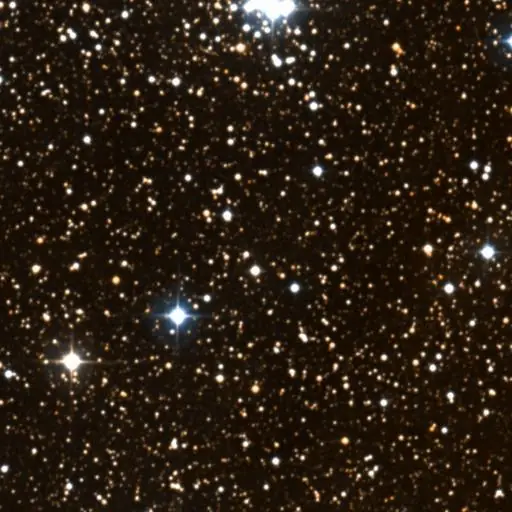
A young Cygnus cluster discovered three times — and perhaps half of a double cluster with P Cygni.
William Herschel saw this cluster on 20 September 1786 but never published it, and his find stayed unknown until the catalogue historian Wolfgang Steinicke went through his records. Hugo Clemens discovered it again in 1896, and Frank Bellamy a third time in 1903. Dreyer, unaware of Clemens, credited Bellamy when he added it to the Index Catalogue in 1908.
IC 4996 is a young open cluster, and seven of its brightest stars form a tight trapezium.
IC 4996 is 6,400 light-years away: the light we see from it set off around 4380 BC, 1,130 years after the first towns were growing in the Fertile Crescent.
Did you know?
- A double with P Cygni?. IC 4996 lies 28′ from P Cygni, a restless supergiant star that suddenly brightened in 1600. Gaia data support the idea that IC 4996 and a cluster around P Cygni form a double cluster, though it is not yet proven.
How big is it?
Born about 11 million years ago, when great apes were spreading through Africa and Europe. Light itself takes 11 years to cross it. Gaia has picked out 212 stars moving together through space as its members. That’s 2.6 times the distance from the Sun to the nearest star. Shrink our Solar System — the Sun and all eight planets — to the size of a coin, and IC 4996 would be 282 m across (3 football pitches end to end); the nearest star would be a football pitch away, and the Milky Way 2,520 km across.
A 7.3-magnitude open cluster in Cygnus, about 6′ across.
When and where to see it
It is best placed in the evening sky around August, when it crosses the meridian at about 10 pm local time (around midnight in July). It can be seen from everywhere north of 52°S and never sets north of 52°N.
At its highest it stands 78° up from 50°N, 87° up from 35°N, 52° up from the equator, 17° up from 35°S.
Facts
- Type
- Open cluster
- Constellation
- Cygnus
- Designations
- IC 4996
- Magnitude
- 7.3
- Apparent size
- 6.0′
- Position
- RA 20h 16.6m, Dec +37° 33′ (J2000)
- Distance
- 6,400 light-years
- Discovered
- William Herschel, 1786, Unpublished; rediscovered by Hugo Clemens in 1896 and Frank Bellamy in 1903
Open AstroPilot to see when IC 4996 is highest tonight from your location, how easy it is with your telescope or binoculars, and an eyepiece view.