IC 4756
IC 4756 is an open cluster in the constellation Serpens, magnitude 4.6, 24′ across.
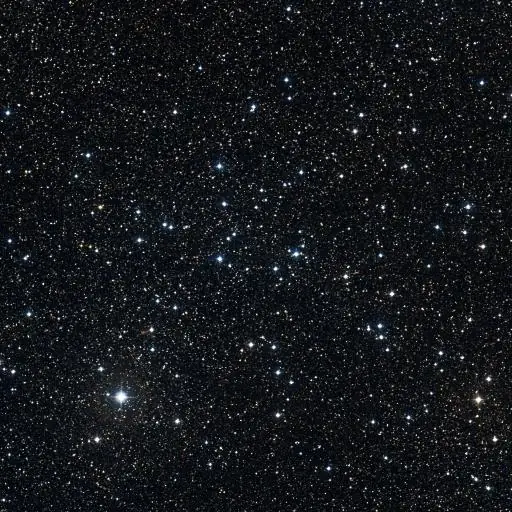
Graff’s Cluster: a bright Serpens cluster paired with NGC 6633 as Tweedledee and Tweedledum.
Lewis Carroll’s twins have a home in the sky. IC 4756 and NGC 6633, two bright open clusters about three degrees apart, are known as Tweedledee and Tweedledum. IC 4756 is also called the Secret Garden Cluster, and Graff’s Cluster: Solon Bailey discovered it, and Kasimir Graff found it again independently in 1922. Its stars have almost exactly the same share of heavy elements as the Sun.
IC 4756 is 1,500 light-years away: the light we see from it set off around AD 530, around the time the Hagia Sophia was completed in Constantinople.
Did you know?
- A star with two rhythms. HD 172189 is an eclipsing binary that dims every 5.7 days, and its main star also pulsates as a Delta Scuti variable, so its light flickers to two different rhythms.
How big is it?
Born about 1.3 billion years ago, when there were no animals on Earth at all. Light itself takes 10 years to cross it. Gaia has picked out 718 stars moving together through space as its members. That’s 2.5 times the distance from the Sun to the nearest star. Shrink our Solar System — the Sun and all eight planets — to the size of a coin, and IC 4756 would be 264 m across (3 football pitches end to end); the nearest star would be a football pitch away, and the Milky Way 2,520 km across.
A 4.6-magnitude open cluster in Serpens, about 24′ across.
When and where to see it
It is best placed in the evening sky around July, when it crosses the meridian at about 10 pm local time (around midnight in July). It can be seen from everywhere north of 85°S and never sets north of 85°N.
At its highest it stands 45° up from 50°N, 60° up from 35°N, 85° up from the equator, 50° up from 35°S.
Facts
- Type
- Open cluster
- Constellation
- Serpens
- Designations
- IC 4756
- Magnitude
- 4.6
- Apparent size
- 24′
- Position
- RA 18h 38.9m, Dec +5° 28′ (J2000)
- Distance
- 1,500 light-years
- Discovered
- Solon Bailey, Found independently by Kasimir Graff in 1922
Open AstroPilot to see when IC 4756 is highest tonight from your location, how easy it is with your telescope or binoculars, and an eyepiece view.