IC 4678
IC 4678 is an emission nebula in the constellation Sagittarius, magnitude 10.4 (blue).
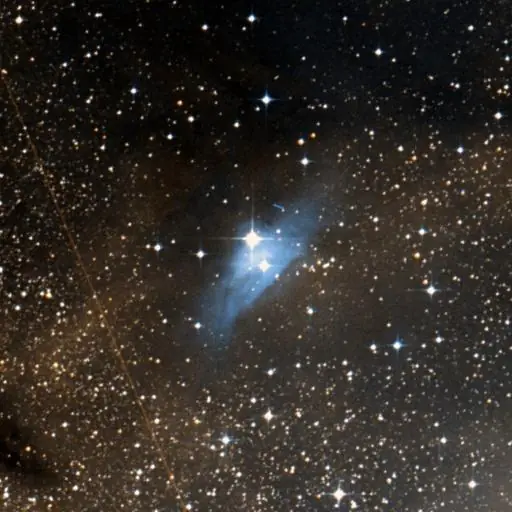
A small cloud of glowing gas in Sagittarius, less than a degree from the Lagoon Nebula.
Sagittarius looks towards the crowded centre of our galaxy, and its Milky Way is full of glowing clouds. The most famous is the Lagoon Nebula, M 8, a stellar nursery bright enough to see without a telescope. IC 4678 is a far more modest emission nebula less than a degree away: a patch of hydrogen gas made to glow by the ultraviolet light of hot young stars.
A 10.4-magnitude (B-band) emission nebula in Sagittarius.
When and where to see it
It is best placed in the evening sky around July, when it crosses the meridian at about 10 pm local time (around midnight in June). It can be seen from everywhere south of 66°N and never sets south of 66°S.
At its highest it stands 16° up from 50°N, 31° up from 35°N, 66° up from the equator, 79° up from 35°S.
Facts
- Type
- Emission nebula
- Constellation
- Sagittarius
- Designations
- IC 4678
- Magnitude
- 10.4 (blue)
- Position
- RA 18h 6.6m, Dec −23° 57′ (J2000)
Open AstroPilot to see when IC 4678 is highest tonight from your location, how easy it is with your telescope or binoculars, and an eyepiece view.