IC 4665 (Mel 179)
IC 4665 (Mel 179) is an open cluster in the constellation Ophiuchus, magnitude 4.2, 25′ across.
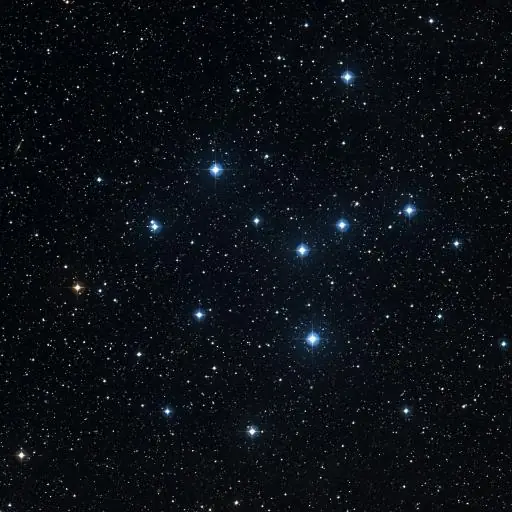
The Summer Beehive: one of the brightest star clusters that both Messier and Herschel left out.
Charles Messier and William Herschel catalogued hundreds of clusters between them, yet neither included IC 4665 — probably because it is so loose and scattered. It is one of the brightest clusters left off their lists. The Swiss astronomer Jean-Philippe Loys de Chéseaux had found it back in 1745. Nicknamed the Summer Beehive and Poseidon’s Trident, this open cluster is young: the lithium in its stars suggests it began to form about 55 million years ago.
IC 4665 (Mel 179) is 1,100 light-years away: the light we see from it set off around AD 930, around the time al-Sufi described the Andromeda Galaxy in his Book of Fixed Stars.
Did you know?
- A slow-motion collision. IC 4665 appears to be colliding with the older cluster Collinder 350, about 4° away in our sky. The two formed far apart, and nobody yet knows whether they will merge.
How big is it?
Born about 33 million years ago, when the Himalayas and the Alps were rising. Light itself takes 7.9 years to cross it. Gaia has picked out 308 stars moving together through space as its members. That’s 1.9 times the distance from the Sun to the nearest star. Shrink our Solar System — the Sun and all eight planets — to the size of a coin, and IC 4665 would be 199 m across (2 football pitches end to end); the nearest star would be a football pitch away, and the Milky Way 2,520 km across.
A 4.2-magnitude open cluster in Ophiuchus, about 25′ across.
When and where to see it
It is best placed in the evening sky around July, when it crosses the meridian at about 10 pm local time (around midnight in June). It can be seen from everywhere north of 84°S and never sets north of 84°N.
At its highest it stands 46° up from 50°N, 61° up from 35°N, 84° up from the equator, 49° up from 35°S.
Facts
- Type
- Open cluster
- Constellation
- Ophiuchus
- Designations
- Mel 179, Cr 349, Melotte 179, Collinder 349
- Magnitude
- 4.2
- Apparent size
- 25′
- Position
- RA 17h 46.5m, Dec +5° 39′ (J2000)
- Distance
- 1,100 light-years
- Discovered
- Jean-Philippe Loys de Chéseaux, 1745
Open AstroPilot to see when IC 4665 (Mel 179) is highest tonight from your location, how easy it is with your telescope or binoculars, and an eyepiece view.