IC 4651
IC 4651 is an open cluster in the constellation Ara, magnitude 6.9, 9.6′ across.
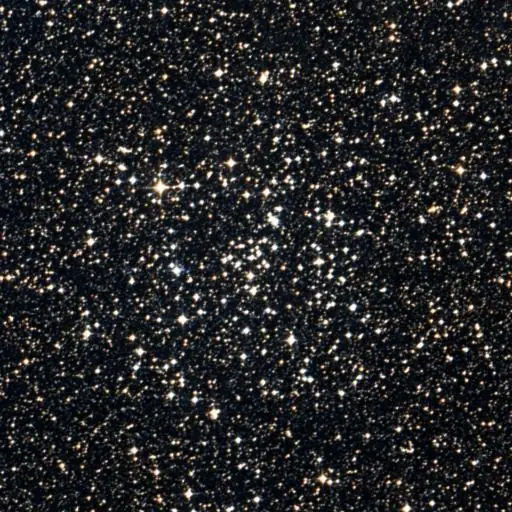
A billion-year-old cluster in Ara whose shining stars are just 7% of what it was born with.
Star clusters slowly fall apart, and IC 4651 shows how far the process can go. Born about 1.2 billion years ago, this open cluster now holds only about 7% of its original mass in shining stars. Roughly a third of that original mass has turned into white dwarfs and other stellar remnants; the rest has drifted off into the Milky Way. Its stars are richer than the Sun in elements heavier than hydrogen and helium.
IC 4651 is 3,000 light-years away: the light we see from it set off around 980 BC, 200 years before the first recorded Olympic Games were held.
Did you know?
- A possible planet. One of its stars, IC 4651 9122, shows wobbles that hint at an orbiting planet, though stellar activity cannot yet be ruled out as the cause.
How big is it?
Born about 1.7 billion years ago, when there were no animals on Earth at all. Light itself takes 8.4 years to cross it. Gaia has picked out 1,015 stars moving together through space as its members. That’s twice the distance from the Sun to the nearest star. Shrink our Solar System — the Sun and all eight planets — to the size of a coin, and IC 4651 would be 211 m across (2 football pitches end to end); the nearest star would be a football pitch away, and the Milky Way 2,520 km across.
A 6.9-magnitude open cluster in Ara, about 9.6′ across.
When and where to see it
It is best placed in the evening sky around July, when it crosses the meridian at about 10 pm local time (around midnight in June). It can be seen from everywhere south of 40°N and never sets south of 40°S.
At its highest it stands below the horizon from 50°N, 5° up from 35°N, 40° up from the equator, 75° up from 35°S.
Facts
- Type
- Open cluster
- Constellation
- Ara
- Designations
- IC 4651
- Magnitude
- 6.9
- Apparent size
- 9.6′
- Position
- RA 17h 24.8m, Dec −49° 56′ (J2000)
- Distance
- 3,000 light-years
- Discovered
- First catalogued by J. L. E. Dreyer in the 1895 Index Catalogue
Open AstroPilot to see when IC 4651 is highest tonight from your location, how easy it is with your telescope or binoculars, and an eyepiece view.