IC 4605
IC 4605 is an emission nebula in the constellation Scorpius, magnitude 4.7 (blue), 30′ × 15′ across.
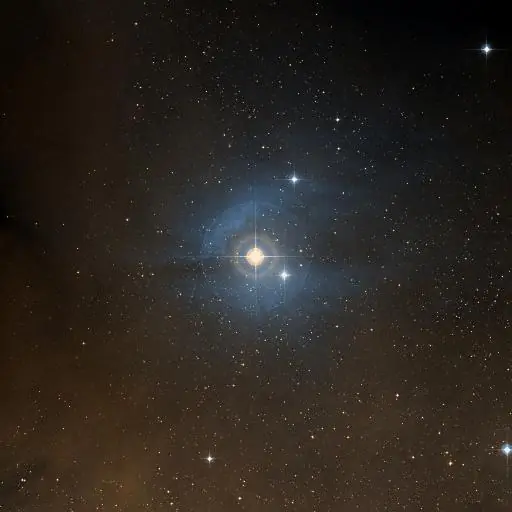
A faint glow around the star 22 Scorpii, on the western edge of the Rho Ophiuchi clouds.
About a degree from Antares, the star 22 Scorpii sits in, or just beside, a faint nebula, IC 4605. The star is a hot B-type star, ten million years old, spinning fast and shining about 600 times as brightly as the Sun, and its light makes the surrounding gas and dust glow. The cloud belongs to the western reaches of the Rho Ophiuchi complex, one of the nearest regions of star birth to the Sun.
IC 4605 is 380 light-years away: the light we see from it set off around 1645, 35 years after Galileo first turned a telescope to the sky.
How big is it?
3,490 Solar Systems side by side. Light itself takes 3.3 years to cross it. Shrink our Solar System — the Sun and all eight planets — to the size of a coin, and IC 4605 would be 83.7 m across (about the length of a football pitch); the nearest star would be a football pitch away, and the Milky Way 2,520 km across.
An emission nebula in Scorpius, about 30′ × 15′. Its catalogued magnitude, 4.7 (B-band), is that of the star lighting it; the nebula itself is much fainter.
When and where to see it
It is best placed in the evening sky around June, when it crosses the meridian at about 10 pm local time (around midnight in May). It can be seen from everywhere south of 65°N and never sets south of 65°S.
At its highest it stands 15° up from 50°N, 30° up from 35°N, 65° up from the equator, 80° up from 35°S.
Facts
- Type
- Emission nebula
- Constellation
- Scorpius
- Designations
- IC 4605
- Magnitude
- 4.7 (blue)
- Apparent size
- 30′ × 15′
- Position
- RA 16h 30.2m, Dec −25° 7′ (J2000)
- Distance
- 380 light-years
Open AstroPilot to see when IC 4605 is highest tonight from your location, how easy it is with your telescope or binoculars, and an eyepiece view.