IC 447 (IC 2169)
IC 447 (IC 2169) is an emission nebula in the constellation Monoceros, magnitude 7.7 (blue), 25′ × 20′ across.
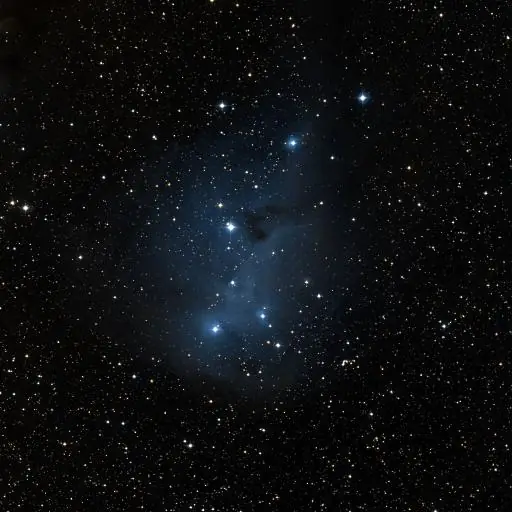
A cloud of gas and dust in Monoceros, lit by hot young stars at one end of a long star-forming cloud.
Monoceros R1 is a long cloud of cold gas and dust, and IC 447 marks one end of it, with IC 446 at the other. Several massive, hot B-type stars are embedded in the nebula, lighting up its dust and gas. They may belong to the young open cluster Collinder 95, whose biggest stars could have shaped the cloud we see. It carries two Index Catalogue numbers: IC 447 and IC 2169.
IC 447 (IC 2169) is 2,100 light-years away: the light we see from it set off around 80 BC, 155 years before Vesuvius buried Pompeii.
How big is it?
3.6 times the distance from the Sun to the nearest star. Light itself takes 15 years to cross it. Shrink our Solar System — the Sun and all eight planets — to the size of a coin, and IC 447 would be 385 m across (4 football pitches end to end); the nearest star would be a football pitch away, and the Milky Way 2,520 km across.
A 7.7-magnitude (B-band) emission nebula in Monoceros, about 25′ × 20′.
When and where to see it
It is best placed in the evening sky around January, when it crosses the meridian at about 10 pm local time (around midnight in December). It can be seen from everywhere north of 80°S and never sets north of 80°N.
At its highest it stands 50° up from 50°N, 65° up from 35°N, 80° up from the equator, 45° up from 35°S.
Facts
- Type
- Emission nebula
- Constellation
- Monoceros
- Designations
- IC 2169
- Magnitude
- 7.7 (blue)
- Apparent size
- 25′ × 20′
- Position
- RA 6h 31.0m, Dec +9° 54′ (J2000)
- Distance
- 2,100 light-years
Open AstroPilot to see when IC 447 (IC 2169) is highest tonight from your location, how easy it is with your telescope or binoculars, and an eyepiece view.