Jellyfish Nebula (IC 443)
Jellyfish Nebula (IC 443) is a supernova remnant in the constellation Gemini, magnitude 12.0 (blue), 50′ × 40′ across.
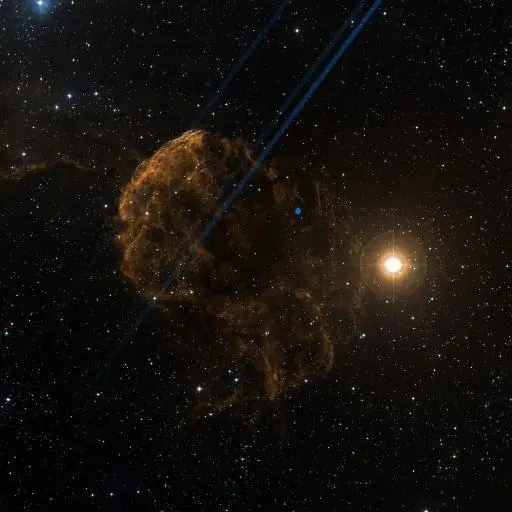
The Jellyfish Nebula: the tattered shell of an exploded star, still crashing into dark clouds.
A massive star once collapsed and exploded in Gemini, near the star Eta Geminorum at Castor’s foot. The Jellyfish Nebula is the wreckage: a ragged, shell-shaped supernova remnant whose curving rim and trailing filaments look like a jellyfish in photographs. The explosion also left behind a neutron star — the crushed core of the star — which still sits near the remnant’s southern rim.
Nobody is sure when it happened. Estimates range from about 3,000 to more than 30,000 years ago.
Jellyfish Nebula (IC 443) is 5,200 light-years away: the light we see from it set off around 3180 BC, around the time writing was invented in Mesopotamia.
Did you know?
- Ploughing into clouds. IC 443 is one of the best-studied cases of a supernova remnant colliding with dense molecular clouds. A giant cloud in front of it also absorbs much of its light.
- An older ghost. A third, larger shell once counted as part of IC 443 is now known to be a separate, older remnant, about 100,000 years old.
How big is it?
18 times the distance from the Sun to the nearest star. Light itself takes 76 years to cross it. Shrink our Solar System — the Sun and all eight planets — to the size of a coin, and the Jellyfish Nebula would be 1.91 km across (a 25-minute walk); the nearest star would be a football pitch away, and the Milky Way 2,520 km across.
A large, faint supernova remnant requiring dark skies and nebula filters.
When and where to see it
It is best placed in the evening sky around January, when it crosses the meridian at about 10 pm local time (around midnight in December). It can be seen from everywhere north of 67°S and never sets north of 67°N.
At its highest it stands 63° up from 50°N, 78° up from 35°N, 67° up from the equator, 32° up from 35°S.
Facts
- Type
- Supernova remnant
- Constellation
- Gemini
- Designations
- IC 443, Gem A
- Magnitude
- 12.0 (blue)
- Apparent size
- 50′ × 40′
- Position
- RA 6h 16.6m, Dec +22° 32′ (J2000)
- Distance
- 5,200 light-years
- Discovered
- Max Wolf
Open AstroPilot to see when Jellyfish Nebula (IC 443) is highest tonight from your location, how easy it is with your telescope or binoculars, and an eyepiece view.