IC 4406
IC 4406 is a planetary nebula in the constellation Lupus, magnitude 10.2, 35″ across.
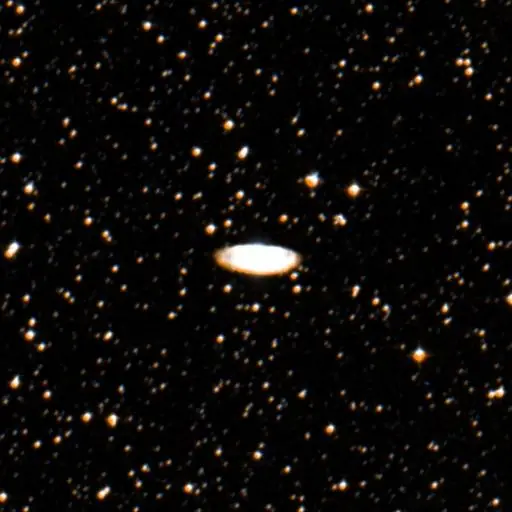
The Retina Nebula: a ring of gas and dust seen almost side-on, so that it looks like a rectangle.
From above, IC 4406 would probably look like a ring. We see it from the side instead, almost in the plane of its equator, so the doughnut of gas and dust thrown off by a dying star appears as a rectangle. Across it run dark, lacy knots of dust, which some liken to the retina at the back of an eye — the source of this planetary nebula’s nickname. Its central star has a spectrum like a Wolf–Rayet star’s, and Gaia data hint that it may have a companion.
IC 4406 is 3,600 light-years away: the light we see from it set off around 1580 BC, 250 years before Tutankhamun was buried in the Valley of the Kings.
Did you know?
- Hidden rings. Very Large Telescope images reveal at least five faint ring-like arcs to the north and south of the main nebula.
How big is it?
639 Solar Systems side by side. Light itself takes 7 months to cross it. Shrink our Solar System — the Sun and all eight planets — to the size of a coin, and IC 4406 would be 15.3 m across (about the length of a bus); the nearest star would be a football pitch away, and the Milky Way 2,520 km across.
A 10.2-magnitude planetary nebula in Lupus, about 35″ across. Its central star is magnitude 17.4 (B-band).
When and where to see it
It is best placed in the evening sky around May, when it crosses the meridian at about 10 pm local time (around midnight in April). It can be seen from everywhere south of 46°N and never sets south of 46°S.
At its highest it stands below the horizon from 50°N, 11° up from 35°N, 46° up from the equator, 81° up from 35°S.
Facts
- Type
- Planetary nebula
- Constellation
- Lupus
- Designations
- IC 4406
- Magnitude
- 10.2
- Apparent size
- 35″
- Position
- RA 14h 22.4m, Dec −44° 9′ (J2000)
- Distance
- 3,600 light-years
- Discovered
- DeLisle Stewart
Open AstroPilot to see when IC 4406 is highest tonight from your location, how easy it is with your telescope or binoculars, and an eyepiece view.