IC 434
IC 434 is an emission nebula in the constellation Orion, magnitude 11.0 (blue), 1.5° × 30′ across.
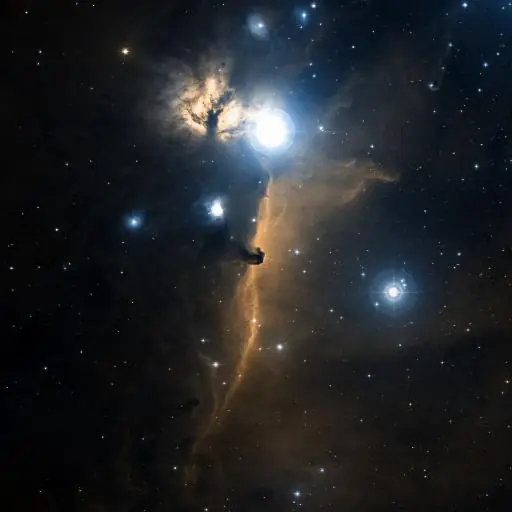
The glowing curtain behind the Horsehead, lit by the hot stars of Sigma Orionis.
Without IC 434 behind it, the Horsehead would be invisible. This sheet of glowing hydrogen, an emission nebula, stretches south from Orion’s Belt, and the famous horse’s head is a cloud of dark dust silhouetted against it. The light comes from Sigma Orionis, a hot multiple star whose ultraviolet radiation makes the gas glow red. William Herschel recorded the nebula on 1 February 1786 — about a century before the Horsehead itself was noticed on a photograph.
IC 434 is 1,300 light-years away: the light we see from it set off around AD 730, 75 years before Charlemagne was crowned emperor.
Did you know?
- Young as nebulae go. IC 434 is one of the youngest glowing regions to form around the hot stars of the Orion OB1 association, the family of massive stars that includes Orion’s Belt.
How big is it?
8 times the distance from the Sun to the nearest star. Light itself takes 34 years to cross it. Shrink our Solar System — the Sun and all eight planets — to the size of a coin, and IC 434 would be 859 m across (8 football pitches end to end); the nearest star would be a football pitch away, and the Milky Way 2,520 km across.
An 11.0-magnitude (B-band) emission nebula in Orion, about 90′ × 30′. The dark Horsehead Nebula (Barnard 33) is silhouetted against its glow.
When and where to see it
It is best placed in the evening sky around January, when it crosses the meridian at about 10 pm local time (around midnight in December). It can be seen from everywhere south of 88°N and never sets south of 88°S.
At its highest it stands 38° up from 50°N, 53° up from 35°N, 88° up from the equator, 57° up from 35°S.
Facts
- Type
- Emission nebula
- Constellation
- Orion
- Designations
- IC 434
- Magnitude
- 11.0 (blue)
- Apparent size
- 1.5° × 30′
- Position
- RA 5h 41.0m, Dec −2° 27′ (J2000)
- Distance
- 1,300 light-years
- Discovered
- William Herschel, 1786
Open AstroPilot to see when IC 434 is highest tonight from your location, how easy it is with your telescope or binoculars, and an eyepiece view.