IC 4291
IC 4291 is an open cluster in the constellation Centaurus, magnitude 9.7, 5.1′ across.
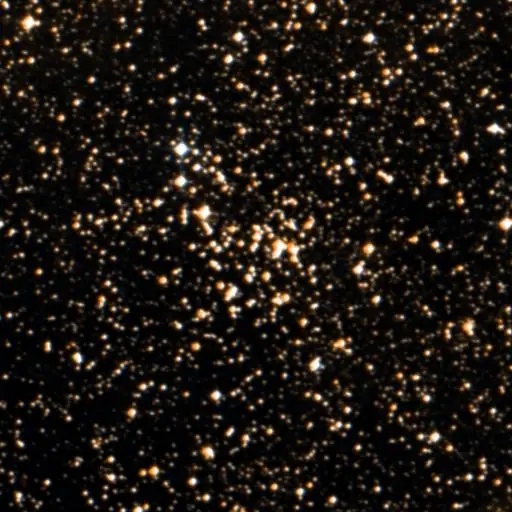
A star cluster in Centaurus whose other name honours Paris Pişmiş, a pioneer of astronomy in Mexico.
Many star clusters have more than one name, and IC 4291’s second one honours a remarkable astronomer. In research catalogues it is Pismis 18, after Paris Pişmiş, who was born in Istanbul and spent most of her working life in Mexico. She catalogued a series of faint clusters in the southern Milky Way, and this open cluster in Centaurus is one of them. It lies almost exactly on the plane of our galaxy, among the crowded star fields of the Milky Way.
IC 4291 is 8,200 light-years away: the light we see from it set off around 6180 BC, 670 years before the first towns were growing in the Fertile Crescent.
How big is it?
2.9 times the distance from the Sun to the nearest star. Light itself takes 12 years to cross it. Shrink our Solar System — the Sun and all eight planets — to the size of a coin, and IC 4291 would be 307 m across (3 football pitches end to end); the nearest star would be a football pitch away, and the Milky Way 2,520 km across.
A 9.7-magnitude open cluster in Centaurus, about 5.1′ across.
When and where to see it
It is best placed in the evening sky around May, when it crosses the meridian at about 10 pm local time (around midnight in April). It can be seen from everywhere south of 28°N and never sets south of 28°S.
At its highest it stands below the horizon from 50°N, below the horizon from 35°N, 28° up from the equator, 63° up from 35°S.
Facts
- Type
- Open cluster
- Constellation
- Centaurus
- Designations
- IC 4291
- Magnitude
- 9.7
- Apparent size
- 5.1′
- Position
- RA 13h 36.9m, Dec −62° 6′ (J2000)
- Distance
- 8,200 light-years
Open AstroPilot to see when IC 4291 is highest tonight from your location, how easy it is with your telescope or binoculars, and an eyepiece view.