Flaming Star Nebula (IC 405)
Flaming Star Nebula (IC 405) is an emission nebula in the constellation Auriga, magnitude 10.0 (blue), 50′ × 30′ across.
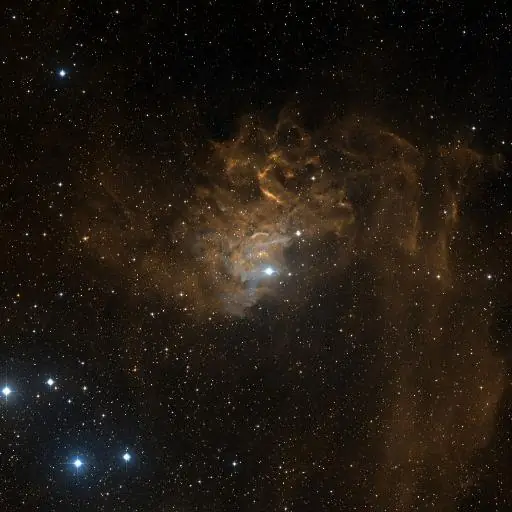
A runaway star, flung out of Orion, now setting a cloud of gas and dust aglow as it passes through.
AE Aurigae is a star on the run. Trace its path back across the sky and it leads towards Orion, where it seems to have been born before being flung out at high speed. Now it is ploughing through a cloud of gas and dust in Auriga, lighting it up as it goes.
The result is the Flaming Star Nebula. Where the star’s ultraviolet light strikes hydrogen, the gas glows as an emission nebula; where it meets dust, the light simply bounces off, as in a reflection nebula. In long-exposure photographs, the wisps around the star look like curling flames.
It is a chance encounter. AE Aurigae was not born in this cloud, and one day it will move on, leaving the gas to fade back into darkness.
Flaming Star Nebula (IC 405) is 1,500 light-years away: the light we see from it set off around AD 530, around the time the Hagia Sophia was completed in Constantinople.
Did you know?
- Flying apart. AE Aurigae has a partner in flight: Mu Columbae, racing away in the opposite direction. Both seem to have been flung out of the same close encounter between stars in Orion, a few million years ago.
- An unsteady flame. AE Aurigae is itself a variable star, brightening and dimming irregularly — so the light that sets its nebula aglow is never quite steady.
How big is it?
5.1 times the distance from the Sun to the nearest star. Light itself takes 22 years to cross it. Shrink our Solar System — the Sun and all eight planets — to the size of a coin, and the Flaming Star Nebula would be 551 m across (5 football pitches end to end); the nearest star would be a football pitch away, and the Milky Way 2,520 km across.
A nebula in Auriga lit by the runaway star AE Aurigae, mixing red emission and blue reflection; a challenging visual target.
When and where to see it
It is best placed in the evening sky around January, when it crosses the meridian at about 10 pm local time (around midnight in December). It can be seen from everywhere north of 56°S and never sets north of 56°N.
At its highest it stands 74° up from 50°N, 89° up from 35°N, 56° up from the equator, 21° up from 35°S.
Facts
- Type
- Emission nebula
- Constellation
- Auriga
- Designations
- IC 405, C 31
- Magnitude
- 10.0 (blue)
- Apparent size
- 50′ × 30′
- Position
- RA 5h 16.5m, Dec +34° 21′ (J2000)
- Distance
- 1,500 light-years
- Discovered
- John Martin Schaeberle, 1892
Open AstroPilot to see when Flaming Star Nebula (IC 405) is highest tonight from your location, how easy it is with your telescope or binoculars, and an eyepiece view.