IC 356
IC 356 is a galaxy in the constellation Camelopardalis, magnitude 10.2, 4.0′ × 3.7′ across.
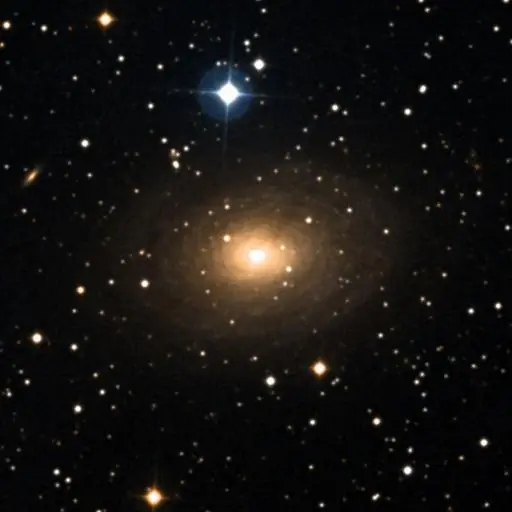
A spiral galaxy in the Giraffe, glimpsed through the dusty outskirts of our own Milky Way.
Camelopardalis, the Giraffe, is a large, faint constellation of the far northern sky, added to star maps in the early 1600s by the Flemish-born mapmaker Petrus Plancius. Its stars are dim, but it holds a number of galaxies. IC 356 is one: an Sb spiral galaxy, with moderately wound arms around a fair-sized central bulge. It lies not far from the band of the Milky Way, so its light reaches us through the dusty outskirts of our own galaxy.
IC 356 is 61 million light-years away: the light we see from it set off about 61 million years ago, when mammals were taking over a world without dinosaurs.
How big is it?
71% of the Milky Way’s width. Light itself takes 71,000 years to cross it. Shrink it to the length of a football pitch and our whole Solar System would be smaller than a bacterium.
A 10.2-magnitude spiral galaxy (Sb) in Camelopardalis, about 4′ × 3.7′.
When and where to see it
It is best placed in the evening sky around December, when it crosses the meridian at about 10 pm local time (around midnight in November). It can be seen from everywhere north of 20°S and never sets north of 20°N.
At its highest it stands 70° up from 50°N, 55° up from 35°N, 20° up from the equator, below the horizon from 35°S.
Facts
- Type
- Galaxy
- Constellation
- Camelopardalis
- Designations
- IC 356
- Magnitude
- 10.2
- Apparent size
- 4.0′ × 3.7′
- Position
- RA 4h 7.8m, Dec +69° 49′ (J2000)
- Distance
- 61 million light-years
Open AstroPilot to see when IC 356 is highest tonight from your location, how easy it is with your telescope or binoculars, and an eyepiece view.