Barnard's Merope Nebula (IC 349)
Barnard's Merope Nebula (IC 349) is a reflection nebula in the constellation Taurus, 30″ × 30″ across.
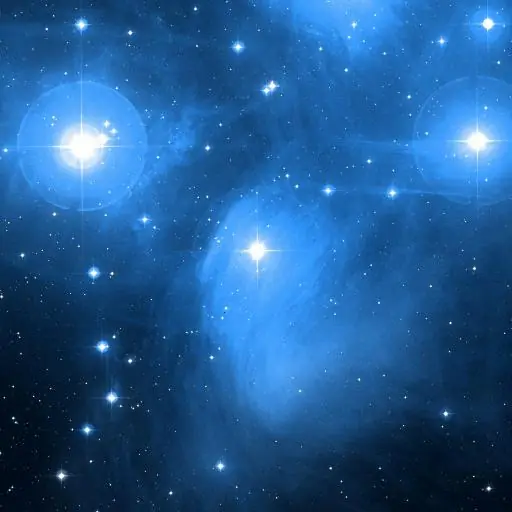
A small cloud of dust being torn apart as it drifts past Merope, a star of the Pleiades.
Most of the blue haze around the Pleiades is a wide veil of dust lit by the cluster’s stars. IC 349 is different: a small, dense knot, a reflection nebula lying very close to the star Merope. It is not even travelling with the cluster. Its motion matches the gas of the nearby Taurus clouds, so it is probably a stray that has wandered into Merope’s glare — and the star’s radiation, its wind, or both, are now tearing it apart.
Barnard's Merope Nebula (IC 349) is 440 light-years away: the light we see from it set off around 1585, 25 years before Galileo first turned a telescope to the sky.
Did you know?
- Who saw it first?. E. E. Barnard announced it in 1890 as a comet-like nebula. Charles Pritchard claimed to have caught it on an Oxford photograph in 1889, yet dismissed it as an “apparently insignificant fleck”.
- No star inside. Astronomers searched its bright knot for a hidden newborn star, in visible and infrared light. They found none — only very fine dust scattering Merope’s light.
How big is it?
67 Solar Systems side by side. Light itself takes 23 days to cross it. Shrink our Solar System — the Sun and all eight planets — to the size of a coin, and Barnard's Merope Nebula would be 1.6 m across (about the height of a door); the nearest star would be a football pitch away, and the Milky Way 2,520 km across.
A reflection nebula in Taurus, about 30″ across.
When and where to see it
It is best placed in the evening sky around December, when it crosses the meridian at about 10 pm local time (around midnight in November). It can be seen from everywhere north of 66°S and never sets north of 66°N.
At its highest it stands 64° up from 50°N, 79° up from 35°N, 66° up from the equator, 31° up from 35°S.
Facts
- Type
- Reflection nebula
- Constellation
- Taurus
- Designations
- IC 349
- Apparent size
- 30″ × 30″
- Position
- RA 3h 46.3m, Dec +23° 56′ (J2000)
- Distance
- 440 light-years
- Discovered
- E. E. Barnard, 1890
Open AstroPilot to see when Barnard's Merope Nebula (IC 349) is highest tonight from your location, how easy it is with your telescope or binoculars, and an eyepiece view.